The results could have important implications for agricultural management around the timing and intensity of water and pesticide applications.
"These soils are very fertile and provide the most productive agricultural land in Australia," lead author Dr Anna-Katrin Greve, a postdoctoral fellow with UNSW’s Connected Waters Initiative, said.
"Lower water application intensity will give soil cracks time to close and more frequent irrigations could prevent the soil cracks from reforming."
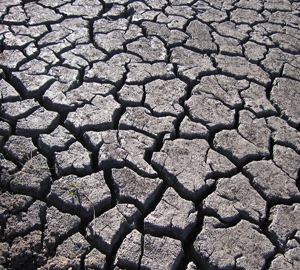
These cracks, which form during extended dry periods, provide "preferential pathways" allowing water to flow much faster than it would through non-cracked soil.
This means nutrients and pesticides are rapidly transported beyond the crops’ root-zone, said Greve, and if the plants can't access the water it has effectively been wasted.
By sending an electrical current through the ground at different angles, the UNSW researchers can measure directional differences in current conduction, which offers clues about how water is moving through the soil.
This innovative technique means they can, for the first time, detect the exact time when preferential sub-surface pathways close. This is important for irrigators, as water flow through non-cracked soil is far more predictable.
Their findings, which have been accepted for publication in the journal Geoderma, reveal that surface appearances can be deceiving.
"We showed that soil cracks that developed in dry periods remain open as preferential flow paths, even after the cracks are visually closed," Greve said.
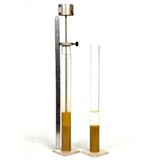
Researchers measured the flow of electrical current through a soil profile that was set-up over several years. The soil was contained in a fibreglass barrel, which had a small drain at the base.
Two irrigation events were carried out approximately 14 days apart. Each event used water from different sources, meaning the two samples had different stable isotope signatures, allowing researchers to distinguish between them.
At the time of the first irrigation event there were visible cracks upwards of three centimetres wide in the soil. By the time of the second irrigation, these cracks had visibly closed.
Despite this surface closure, the water from the second irrigation actually drained faster. It bypassed the sections of the soil where water from the first event was presumably stored and drained with signs of limited mixing, researchers said, meaning preferential flow paths must have remained open.
Greve’s study was awarded best paper at a geoscience conference in Europe in 2011 and she recently presented her findings at a conference in Arizona.