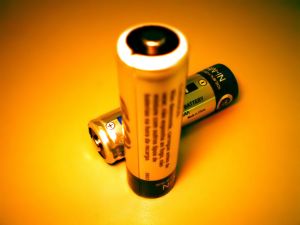
Tristan Simons, a Phd student with Deakin’s Institute for Frontier Materials, is part of a research team working on the development of bigger, greener, rechargeable batteries that can store the large amounts of energy generated by the likes of wind turbines and solar panels.
Simons said the project aimed to update 100 year-old zinc air battery technology to serve the energy storage needs of 21st century.
"You might believe that solar and wind power is a great way to move away from dirty, carbon emitting fossil fuels," Simons said.
"It’s a wonderful image; the world’s energy needs being met by a bright sunny day, or a cool pleasant breeze. But what stops the lights going out when the sun doesn’t shine or the wind doesn’t blow? The answer to this question lies in energy storage.
"We know that renewable energy sources don’t give an uninterrupted supply of power, so it’s important to save some up for a rainy day. The simplest solution is to use our wind turbine or solar panel to charge up a battery, which we can use later, where and when we need it."
Simons explained that the problem with this theory is that: "we simply don’t have a rechargeable battery that is cheap enough or green enough to do this job".
"This is my project, the zinc-air rechargeable battery. It’s the bigger, better, greener, cheaper battery that can store huge amounts of energy where it’s generated, then dispense it where and when it’s needed," he said.
"This battery uses zinc metals - one of our cheapest and most produced metals - at the negative terminal and oxygen - taken straight from the air – at the positive terminal to generate electricity. However, this wonderful piece of clean technology has a drawback – it cannot be recharged.
"One of the main reasons that it can’t be recharged is that when we use the battery the zinc metal from the negative terminal dissolves it into a liquid inside the battery known as an electrolyte. When we recharge the battery we need to put the zinc back again just the way we found it, as a nice smooth service, otherwise the battery short circuits and dies.
"In my project, I’ve gone away and made some new electrolytes and I’ve found that I can deposit zinc from my electrolytes, but changes in the recipe can give drastically different shapes of zinc. If you add some water, it creates a nice smooth surface made of tiny needles. Take the water away, and the zinc shape becomes a jagged spongy mess.
"These initial findings are my first steps towards making a rechargeable zinc-air battery, which could hold the key to letting all of us, save the planet."


-160x160-state_article-rel-cat.png)