
Key Takeaways
Basic stations: individual Australian listings seen in October 2026 advertised new basic bagging stations from $8,500 ex GST (single) and $19,000 ex GST (double). Confirm current pricing and scope with the seller.
Used frames: individual used frames without weighing were advertised at about $3,500 and $4,500 over the same period. These are examples, not market averages.
Larger systems: weighing fillers with densification, dust sealing and conveyors are quoted per project. Feed, dust collection and integration scope drive the price more than the frame does.
Measure your giveaway: 0.5% overfill on 1,000 kg bags is 5 kg a bag, which can reach hundreds of tonnes a year at production volumes. How much a better filler recovers depends on your current overfill and the accuracy it achieves on your product.
Tax treatment: an eligible small business can write off a filler costing under $20,000 immediately under the now-permanent instant asset write-off, subject to eligibility and simplified depreciation rules. Dearer systems go into the small business pool at 15% in year one and 30% after that.
How much does a bulk bag filler cost in Australia?
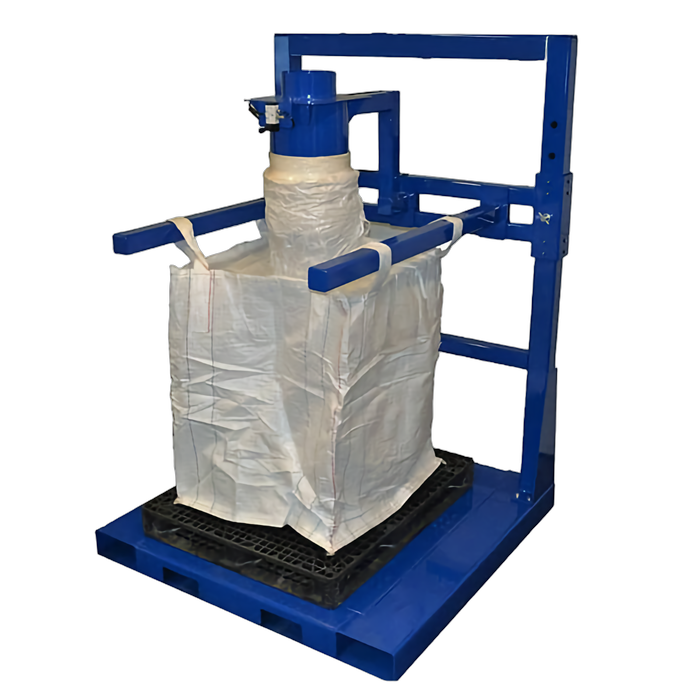
The cost ranges from a few thousand dollars for a used frame to a project-priced automated line. There is no single typical price, because "bulk bag filler" covers everything from a steel frame with hooks to a weighing, densifying, conveyor-fed system.
Individual advertised listings on an Australian machinery marketplace, seen in October 2026 search results:
New single bagging station: from $8,500 ex GST (Telford Smith)
New double bagging station: from $19,000 ex GST (Telford Smith)
Used heavy-duty frame, 3.3 m high: $4,545 ex GST
Used frame with a stainless feeder: $3,500, listed in Victoria
Listings change often and may differ in scope, so treat these as reference points and confirm with the seller.
Tier | What you get | Price guide |
|---|---|---|
Basic frame or station | Steel frame, loop hooks, fill spout, sometimes height adjustment. Little or no weighing | Individual listings from about $3,500 used and $8,500 ex GST new |
Semi-automatic weighing filler | Load cells, inflatable spout seal, liner inflation, densification table, adjustable fill head | Quote-based: compare at least three like-for-like quotes |
Automated filling system | Feed metering, pallet handling, accumulation conveyors, central controls | Priced per project, including integration |
Suppliers on IndustrySearch include Premier Tech Systems and Automation, Packweigh Equipment, Fresco Systems Australasia, Australian Weighing Equipment, Associated Scale Services, Telford Smith, Aurora Process Solutions, Allpack Packaging Technologies, Flexicon and WAM Australia.
What drives the quoted price?
Weighing: none, platform load cells, or hang-weigh load cells, and whether the scale must be trade approved.
Densification: a vibrating table that settles product for a fuller, more stable bag.
Dust control: an inflatable spout seal and an extraction connection.
Ergonomics: a powered height-adjustable fill head and automatic loop release.
Automation: feed control, pallet dispensing and filled-bag conveyors.
Construction: mild steel, galvanised or stainless contact parts.
Costs that usually sit outside the filler price
Feed equipment: the hopper, screw conveyor or rotary valve feeding the filler.
Dust collection: the dust collector or extraction system itself.
Trade measurement: verification by a servicing licensee if you sell by weight.
Hazardous area: rated equipment, if your product creates a combustible dust hazard.
Site services: compressed air for pneumatic seals and clamps, plus electrical work.
Installation: delivery, commissioning and operator training.
What does a bulk bag filler cost to run?
Bags and liners are the visible consumable. Single-trip bags rated 5:1 are designed for one fill, so bag cost is a per-fill cost unless you buy multi-trip bags rated 6:1.
Overfill is the cost most buyers don't measure. It comes from inaccurate weighing, slow feed cut-off or product still falling when the feed stops.
Illustrative example:
Overfill: 0.5% on a 1,000 kg bag, so 5 kg per bag
Volume: 10 bags/h × 16 h/day × 250 days = 40,000 bags a year
Product given away: 40,000 × 5 kg = 200 tonnes a year
At an assumed $500 per tonne, that is $100,000 a year
This shows the cost of giveaway, not a guaranteed saving. Any saving depends on your current overfill, the filling accuracy a new system achieves on your product, and your product's value. Measure your actual overfill first, then ask suppliers what they can achieve on your material.
Other running costs:
Labour: operator time per bag, mostly spent hanging loops, fitting the spout and removing the filled bag.
Cleaning: dust housekeeping and cleaning time.
Maintenance: load cell checks, seal replacement and scale calibration or verification.
Should you buy new or used?
A used filler suits simple, non-trade weighing applications. Worldwide used bulk bag filler listings on one marketplace ranged from US$2,200 to US$21,800 when checked in October 2026.
Check before buying:
whether the load cells and indicator still work, and whether they can be verified for trade if needed
whether hook height suits your bag sizes
whether dust seals and pneumatics are complete
whether spare parts are still available
How to compare bulk bag filler quotes like for like
Check that every quote states:
rated fill rate in bags per hour for your product and bag size
weighing type, scale accuracy and expected filling accuracy, and whether the scale is trade approved
densification, dust sealing and liner inflation inclusions
which feed and dust collection equipment is included
hook height range and bag sizes covered
installation, commissioning and training
warranty, local service location and spare parts pricing
FAQs
Can I claim a bulk bag filler under the instant asset write-off?
Yes, if it costs less than $20,000, your aggregated turnover is under $10 million, and you meet the simplified depreciation rules. The permanent $20,000 threshold from 1 July 2026 is now law. Assets costing $20,000 or more can go into the small business pool, depreciated at 15% in the first year and 30% each year after. Confirm your position with your accountant.
Is a basic frame enough?
For occasional filling with a separate scale and no trade weighing, often yes. A weighing filler becomes worth considering when volume, dust exposure or measured overfill make the difference significant.
Can I finance a bulk bag filler?
Yes. Equipment finance or leasing spreads the cost and preserves working capital. Compare total repayments, not just the monthly figure.
Ready to price your filler? Compare bulk bag filler quotes from Australian suppliers. Include your product, bag size, fill weight and bags per hour so the quotes come back comparable.