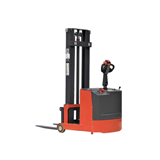
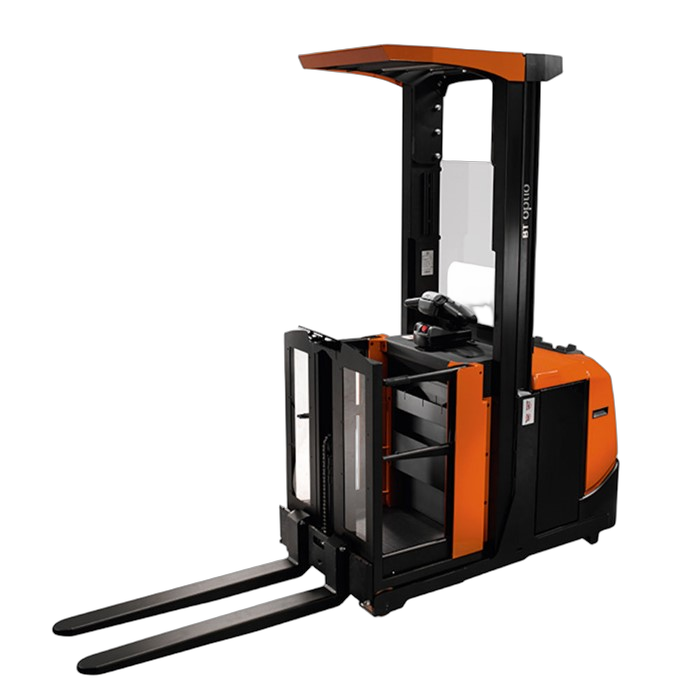

Key takeaways
- Price range: Order pickers cost $8,000-$80,000+ in Australia (2026 AUD) depending on level type - low-level task support from $8,000, mid-level from $20,000, high-level man-up from $40,000.
- Level type is the first decision: Low-level (0-3m) suits ground and first-level picks at retail speed; mid-level (3-6m) covers most distribution centre racking; high-level (6-12m+) serves VNA and deep-rack fulfilment.
- Licence split: Platforms lifting above 1.2m require a High Risk Work Licence LO class (TLILIC2002) at $500-$800 per operator and 2 days of training - low-level task support vehicles operating below 1.2m do not.
- Aisle width: Standard order pickers need 2.5-3.5m aisles; VNA-guided models operate in 1.6-2.0m aisles with wire or rail guidance- aisle width determines whether an order picker fits your existing racking layout.
- Battery: 24V lead acid is standard on low-level units (4-6 hour shift life); 36V/48V lithium-ion is increasingly specified on mid and high-level models with 8+ hour shift life and opportunity charging capability.
- Compliance: All order picker operations require a plant risk assessment under WHS Regulations 2017, daily pre-start checks, and operator competency verification. LO class HRWL is issued by state WHS regulators.
- Low-level, mid-level and high-level order pickers are available from verified Australian suppliers on IndustrySearch.
How to choose an order picker for your warehouse: The level decision most buyers get wrong (2026)
An order picker lifts the operator and a pallet to racking height for direct hand-picking of individual items - the core workflow in e-commerce fulfilment, wholesale distribution, retail replenishment and parts warehousing across Australia. The machine cost ranges from $8,000 for a low-level task support vehicle to $80,000+ for a high-level VNA man-up unit. But most warehouses overspend by sizing for maximum racking height instead of the level where 80% of picks actually happen.
This guide walks warehouse managers, logistics leads and procurement teams through the level type decision, key specifications, pricing and supplier evaluation for order pickers in Australia. To compare pricing from verified Australian suppliers, get quotes for order pickers on IndustrySearch. For operations evaluating whether an order picker or a reach truck better suits their workflow, the forklift buying guide covers the broader material handling equipment landscape.
Operations where order pickers are the standard choice:
- E-commerce and 3PL fulfilment centres picking individual SKUs from multi-level racking
- Wholesale and trade distribution warehouses with high SKU counts and piece-pick workflows
- Retail back-of-house and big-box stores replenishing shelf stock from overhead racking
- Automotive and industrial parts warehouses with small-item, high-variety picking profiles
- Cold storage and pharmaceutical distribution with zone-specific pick requirements
Choose your level type
Before costing anything, confirm which level type suits your pick profile. Your choice here sets your price bracket, aisle width requirement, battery specification and licensing obligation.
Level Type | Pick Height | Best For |
|---|---|---|
Low-level (task support vehicle) |
0-3m |
Ground and first-level picks in retail, light distribution and low-rack warehouses - no LO licence required below 1.2m platform |
Mid-level |
3-6m |
Standard distribution centre racking with 3-4 pick levels - covers 80% of Australian warehouse configurations |
High-level (man-up) |
6-12m+ |
VNA and deep-rack fulfilment with 5+ pick levels - wire or rail-guided for aisle widths under 2m |
Low-level suits you if 70%+ of your picks happen at ground and first shelf level. Task support vehicles like the Crown WAV and Big Joe J1/J2 operate below 1.2m platform height, which means no LO class HRWL is required - a significant saving in training cost and onboarding time for high-turnover operations.
Mid-level suits you if your racking runs 3-4 levels and your pick density justifies lifting the operator rather than using a ladder or step platform. This is the most common order picker configuration in Australian distribution centres running 200+ picks per shift.
High-level suits you if you operate VNA racking above 6m with wire or rail guidance. These units cost $40,000-$80,000+ and require LO-licensed operators, but they unlock up to 30-50% more storage density by reducing aisle widths from 3.5m to 1.6-2.0m, depending on layout.
Evaluate the key specifications
With your level type confirmed, these are the specs that determine whether a given model fits your warehouse operation.
Specification | Typical Range | Buyer Consideration |
|---|---|---|
Platform lift height |
0.8-12m+ |
Match to your top pick level, not your top rack beam - operators pick from chest height, not overhead |
Load capacity (platform) |
500-2,000 kg |
Includes operator weight + pallet + picked items - overloading triggers safety lockouts on modern units |
Aisle width requirement |
1.6-3.5m |
Measure your narrowest aisle before ordering - VNA models under 2m need wire or rail guidance installed |
Travel speed |
6-12 km/h (unladen) |
Speed automatically reduces at height on most models - faster travel matters more than faster lift for pick rate |
Battery |
24V (low) / 36-48V (mid-high) |
Lithium-ion adds 20-30% to unit cost but delivers opportunity charging and 30% longer shift life vs lead acid |
Guidance system |
Free-ranging / wire / rail |
Wire-guided adds $5,000-$15,000 in floor installation but enables VNA operation and reduces rack damage |
Understand the full cost breakdown (2026 prices)
Purchase price is only part of the picture - most cost models that get rejected at approval stage have missed operator licensing, battery infrastructure and maintenance. Here is the full breakdown.
Category | Price Range (AUD) | Typical Configuration |
|---|---|---|
Low-level new (task support, 0-3m) |
$8,000-$15,000 |
24V lead acid, free-ranging, 500 kg platform capacity |
Mid-level new (3-6m) |
$20,000-$45,000 |
36V, free-ranging or wire-guided, 1,000 kg capacity, safety harness anchor |
High-level new (6-12m+ man-up) |
$40,000-$80,000+ |
48V lithium-ion, wire/rail-guided, 1,500-2,000 kg, VNA-rated |
Used/refurbished |
$5,000-$40,000 |
Inspect mast, platform, battery condition, safety systems and compliance tag |
LO licence training (per operator) |
$500-$800 |
2-day course - required for platforms above 1.2m |
Annual maintenance |
$1,500-$4,000/year |
Battery, mast, hydraulics, tyres, safety system inspection |
A mid-level order picker at $25,000-$45,000 with LO licence training for 3 operators ($1,500-$2,400) and first-year maintenance ($1,500-$4,000) totals $28,000-$51,000 in year one. For a unit at $8,000-$80,000+, get quotes for order pickers to compare pricing from verified Australian suppliers.
Plan the asset (depreciation and financing)
The ATO effective life for order picking forklifts is 11 years. Under diminishing value, the depreciation rate is 18.18%; prime cost is 9.09% per annum. The instant asset write-off threshold for 2025-26 is $20,000 - low-level units fall within this; mid and high-level models require standard depreciation scheduling.
Order pickers retain 20-35% residual value at 8-10 years when maintained to manufacturer schedules. Hire and rental arrangements are common at $300-$1,200/week depending on level type, and suit operations with seasonal volume spikes or short-term project-based fulfilment contracts. Hire-to-own converts rental spend to equity over 3-5 year terms.
Evaluate suppliers
You are ready to go to market. Use this checklist to assess each supplier against the same criteria.
Factor | What to Ask |
|---|---|
Pick height and capacity |
What is the maximum platform height and rated capacity at that height for this model? |
Aisle width |
What is the minimum aisle width this model requires? Does it need wire or rail guidance? |
Battery and shift life |
What battery type is fitted and what is the real-world shift life at my planned pick volume? |
Licence requirement |
Does this model require LO class HRWL? Do you provide or arrange licence training? |
Safety systems |
What safety features are standard - harness anchor, auto speed reduction at height, overload lockout? |
Warranty |
What is covered - mast, platform, hydraulics, battery, electronics? Duration? |
Spare parts |
Are mast components, batteries and control modules stocked in Australia? |
Service network |
Do you have mobile service technicians in my state? What is the response time for breakdowns? |
Hire or lease |
Do you offer short-term hire, long-term rental or hire-to-own arrangements? |
Demo and trial |
Can I trial this model in my warehouse with my racking configuration before committing? |
Guidance installation |
If wire or rail guidance is needed, is installation quoted separately? What is the cost per metre of aisle? |
Frequently asked questions
How much does an order picker cost in Australia?
Low-level $8,000-$15,000, mid-level $20,000-$45,000 and high-level $40,000-$80,000+ (2026 AUD). Used units start from $5,000 depending on level type and battery condition.
Does an order picker operator need a high risk work licence?
Platforms lifting above 1.2m require an LO class HRWL (TLILIC2002) at $500-$800 and 2 days training. Low-level vehicles below 1.2m do not require an LO licence but the operator must still be trained and assessed as competent under WHS Regulations 2017.
What aisle width does an order picker need?
Free-ranging models need 2.5-3.5m aisles; wire or rail-guided VNA models operate in 1.6-2.0m. VNA guidance infrastructure costs $5,000-$15,000 per aisle run to install.
When should i choose an order picker over a reach truck?
Order pickers are for hand-picking individual items from racking; reach trucks are for moving full pallets. Many warehouses use both - order pickers for piece-picking and reach trucks for pallet replenishment.
What battery type should i choose for an order picker?
Lead acid costs less upfront and suits low-level units. Lithium-ion adds 20-30% to purchase price but delivers opportunity charging, 30% longer shift life and no watering - increasingly the default on mid and high-level models.
Summary
- Size on your average pick level, not your maximum racking height - most warehouses overspend by buying high-level when mid-level covers 80% of picks
- Low-level task support vehicles ($8,000-$15,000) skip the LO licence requirement entirely - a major saving for high-turnover operations
- Mid-level units ($20,000-$45,000) cover most Australian distribution centre racking configurations
- Aisle width determines whether an order picker fits your existing layout - measure before ordering
- LO class HRWL at $500-$800 per operator and 2 days training is required for platforms above 1.2m
- Lithium-ion batteries add upfront cost but eliminate watering, enable opportunity charging and extend shift life by 30%
Don't waste time contacting suppliers individually. IndustrySearch gives you direct access to verified Australian order picker suppliers - where industrial buyers request and compare multiple quotes so they can buy with confidence.
- Get quotes for order pickers - contact multiple verified suppliers with a single enquiry
- Compare models - filter by level type, lift height, battery and region
- Contact suppliers directly - speak to specialists who service your state
→ Get and compare order picker quotes now → https://www.industrysearch.com.au/buy/order-picker

-160x160-state_article-rel-cat.png)




-160x160-state_article-rel-cat.png)