
Key Takeaways
- Price range: Industrial mobile robots (AMRs) cost $50,000-$250,000+ per unit in Australia depending on payload, navigation system and integration complexity (2026 pricing).
- AMR vs AGV: Autonomous mobile robots (AMRs) navigate dynamically using LiDAR and vision. Automated guided vehicles (AGVs) follow fixed paths via magnetic tape, wire or laser reflectors. AMRs cost more but deploy faster and adapt to layout changes.
- Payload capacity: Ranges from 60 kg (small tote movers) to 1,500 kg+ (pallet-class AMRs). Match to your heaviest standard load, not the occasional maximum.
- If your facility layout changes quarterly or has mixed human-robot traffic: specify an AMR with LiDAR SLAM navigation. If your paths are fixed and the environment is controlled: an AGV at lower cost may be sufficient.
- Integration is the hidden cost: Fleet management software, WMS integration, charging infrastructure and safety validation can add 30-60% to the unit price. Budget $80,000-$400,000 for a 2-3 unit deployment including integration.
- Compliance: AS/NZS 4024.3 (industrial robot safety), AS/NZS 62046 (safety of machinery - detection of persons) and WHS Act risk assessment obligations apply to every deployment.
Industrial Mobile Robot Buying Guide Australia 2026: AMR Types, Navigation Specs, Safety Compliance and Supplier Evaluation for Warehouse and Manufacturing Operations
An industrial mobile robot is a self-navigating platform that transports materials between points in a warehouse, distribution centre or manufacturing facility without fixed infrastructure. Australian operations running 2+ shifts of manual material transport are deploying AMRs to cut internal logistics labour by 40-60% per shift while reducing forklift-pedestrian WHS incidents. With loaded labour costs in NSW and VIC exceeding $38/hour, the payback case for mobile robots is now measured in months, not years, for facilities moving 50+ pallets or 200+ tote loads per shift.
This guide covers configuration, safety and supplier evaluation for industrial mobile robots. Get quotes for industrial mobile robots from verified Australian suppliers on IndustrySearch.
Operations where industrial mobile robots are replacing manual material transport:
- 3PL and distribution centre operators moving totes, cartons and pallets between pick zones and dispatch
- Manufacturing facilities transporting WIP between production cells and assembly stations
- E-commerce fulfilment centres with high-volume goods-to-person picking requirements
- Automotive and FMCG plants feeding parts and raw materials to production lines
Step 1: Choose Your Robot Type
Before costing anything, confirm which navigation and payload class matches your facility layout and material handling task. Your choice here sets your price bracket and integration requirements.
Type | Key Spec | Best For |
|---|---|---|
Tote/carton AMR (60-300 kg) | LiDAR SLAM, shelf/conveyor docking | E-commerce pick zones, parts delivery to assembly |
Pallet AMR (500-1,500 kg) | LiDAR + 3D vision, pallet jack or lift mechanism | Warehouse pallet transport, dock-to-rack, staging |
Mobile manipulator (AMR + cobot arm) | Onboard robotic arm, vision-guided pick | Machine tending, mixed-SKU picking, lab automation |
Magnetic tape, wire or laser reflectors | Fixed routes in controlled environments, assembly line supply |
If your facility layout changes more than twice a year or has shared human-robot traffic zones, specify an AMR with LiDAR SLAM. If your routes are permanently fixed and the environment is controlled with no pedestrian crossings, an AGV delivers the same throughput at 30-50% lower unit cost.
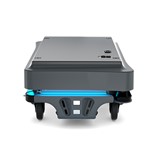
Tote/carton AMRs are the entry point for most Australian warehouses. A 250 kg unit at $50,000-$100,000 replaces 2-3 hours of manual trolley transport per shift and navigates around obstacles without infrastructure changes. Deployment time is typically 2-4 weeks from delivery.
Pallet AMRs handle the heavy end of warehouse logistics. A 1,000 kg unit at $100,000-$200,000 replaces a dedicated forklift run between dock and storage, removing manned forklifts from high-traffic zones - a WHS priority for QLD and VIC facilities under current Safe Work guidance on pedestrian-forklift separation.
Step 2: Evaluate the Key Specifications
With your robot type confirmed, these are the specs that determine whether a given model fits your operation.
Specification | Typical Range | Buyer Consideration |
|---|---|---|
Payload capacity | 60-1,500 kg | Match to your standard load weight. Oversizing wastes capital; undersizing limits throughput |
Navigation type | LiDAR SLAM / magnetic / wire / reflector | LiDAR SLAM adapts to layout changes. Fixed-path requires infrastructure but costs less |
Speed | 1.0-2.0 m/s loaded | Faster speed reduces cycle time but must comply with site safety speed limits |
Battery runtime | 8-16 hours per charge | Must cover a full shift. Opportunity charging docks extend continuous operation |
Minimum aisle width | 800 mm - 2,500 mm | Measure your narrowest aisle. Compact AMRs navigate 800 mm; pallet units need 1,800 mm+ |
Fleet management software | Included or separate licence | Multi-robot deployments (3+ units) require fleet orchestration to prevent congestion and deadlocks |
The most common mistake is costing the robot unit without costing the integration. Fleet software, WMS connectivity, charging stations and safety validation add 30-60% to the unit price. A $100,000 pallet AMR typically costs $160,000-$250,000 fully deployed.
Step 3: Understand the Full Cost Breakdown (2026 Prices)
Purchase price is only part of the picture - integration, software and charging infrastructure drive the total deployment cost well beyond the unit price.
Category | Price Range (AUD) | Typical Configuration |
|---|---|---|
Tote/carton AMR (per unit) | $50,000-$100,000 | 60-300 kg, LiDAR SLAM, shelf docking |
Pallet AMR (per unit) | $100,000-$200,000 | 500-1,500 kg, LiDAR + 3D vision, pallet lift |
AGV (per unit) | $50,000-$150,000 | Fixed-path, magnetic/wire guided, conveyor or fork top |
Integration (2-3 unit fleet) | $30,000-$150,000 | Fleet software, WMS integration, site mapping, charging docks |
Annual maintenance | $3,000-$8,000 per unit | Battery health, sensor calibration, wheel/caster replacement, software updates |
A 3-unit tote AMR fleet at $80,000/unit plus $100,000 integration costs $340,000 deployed. If those 3 units replace 2 FTE forklift/trolley operators at $85,000/year loaded cost each, the fleet pays back within 24 months. At $38/hour loaded in a Sydney or Melbourne DC running 2 shifts, payback drops to 18 months. Get quotes for industrial mobile robots to compare current fleet pricing.
Step 4: Plan the Asset - Depreciation
ATO Depreciation Reference
ATO effective life for industrial robots and automated material handling equipment: 10 years. Diminishing value rate: 20%. Prime cost rate: 10%. A $100,000 pallet AMR depreciates to approximately $33,000 residual at year 10 under diminishing value. Software licences may be separately depreciable over 5 years depending on licence structure.
Compliance Requirements
- AS/NZS 4024.3 (safety of industrial robots) applies to all AMR and AGV deployments in shared human-robot environments
- AS/NZS 62046 (safety of machinery - application of protective equipment to detect the presence of persons) governs pedestrian detection and collision avoidance systems
- WHS Act 2011 risk assessment and PCBU obligations: a documented risk assessment is required before deployment. State WHS regulators in NSW (SafeWork NSW) and VIC (WorkSafe Victoria) provide specific guidance on automated material handling
- Site speed limits: most Australian warehouse deployments restrict AMR speeds to 1.0-1.5 m/s in shared zones as a WHS control measure
Step 5: Evaluate Suppliers
You are ready to go to market. Use this checklist to assess each supplier against the same criteria.
Factor | What to Ask |
|---|---|
Payload and type | Does the supplier offer the payload class and navigation type you need? |
Site assessment | Will the supplier conduct a site assessment including floor condition, aisle widths and traffic patterns? |
WMS integration | Can the fleet software integrate with your existing WMS? What is the integration cost and timeline? |
Fleet management | Is fleet orchestration software included or a separate licence? What is the annual licence cost? |
Safety validation | Does the supplier provide a documented safety validation and risk assessment for your site? |
Deployment timeline | What is the timeline from order to operational deployment including site mapping and integration? |
Warranty | What is the hardware warranty? Is the battery warranted separately? |
Service network | Where is the nearest service technician? What is the response time for breakdowns? |
Pilot program | Can you deploy 1-2 units as a pilot before committing to a full fleet? |
Scalability | Can additional units be added to the fleet without replacing the software or infrastructure? |
Frequently Asked Questions
At what throughput level does an AMR fleet justify its cost over manual material transport?
Operations moving 50+ pallets or 200+ tote loads per shift across distances exceeding 50 m typically achieve payback within 18-24 months on a 2-3 unit fleet replacing 1-2 FTE material handlers.
When should I specify an AMR instead of an AGV for warehouse transport?
When your layout changes more than twice a year, pedestrian traffic shares the same aisles, or you need to add routes without installing floor infrastructure. AMRs adapt to layout changes within hours; AGVs require physical path modifications.
What safety standards apply to mobile robot deployments in Australian warehouses?
AS/NZS 4024.3 (industrial robot safety) and AS/NZS 62046 (personnel detection) apply. A documented WHS risk assessment is required before deployment under PCBU obligations.
What is the typical deployment cost for a 3-unit AMR fleet?
$250,000-$500,000 fully deployed including units, fleet software, WMS integration, charging docks and safety validation. Unit cost is 40-70% of the total; integration is 30-60%.
How long does it take to deploy an AMR from order to operation?
Tote AMRs deploy in 2-6 weeks. Pallet AMRs with WMS integration take 6-12 weeks; AGVs with fixed-path infrastructure take 8-16 weeks.
What Matters Most
- Integration cost is 30-60% of total deployment: budget for software, WMS, charging and safety validation alongside the unit price
- AMR for dynamic layouts; AGV for fixed routes: the navigation type determines cost, flexibility and deployment speed
- Safety compliance is mandatory: AS/NZS 4024.3 and WHS risk assessment before deployment
- Pilot before scaling: deploy 1-2 units to validate throughput and integration before committing to a full fleet
- Payback is 18-24 months at production volume: driven by FTE replacement and WHS risk reduction
Most buyers deploy a 1-2 unit pilot after getting quotes from 2-3 qualified integrators.
Don't waste time contacting suppliers individually. IndustrySearch gives you direct access to verified Australian industrial mobile robot suppliers - where industrial buyers request and compare multiple quotes so they can buy with confidence.
- Get quotes for industrial mobile robots - contact multiple verified suppliers with a single enquiry
- Compare models - filter by capacity, configuration and region
- Contact suppliers directly - speak to specialists who service your state
? Get and compare industrial mobile robot quotes now ?