


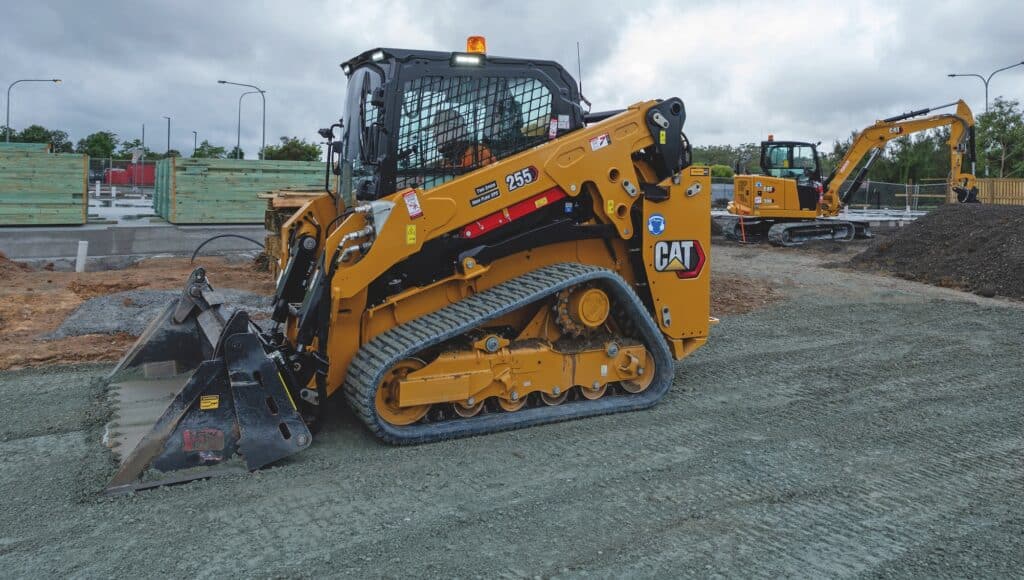
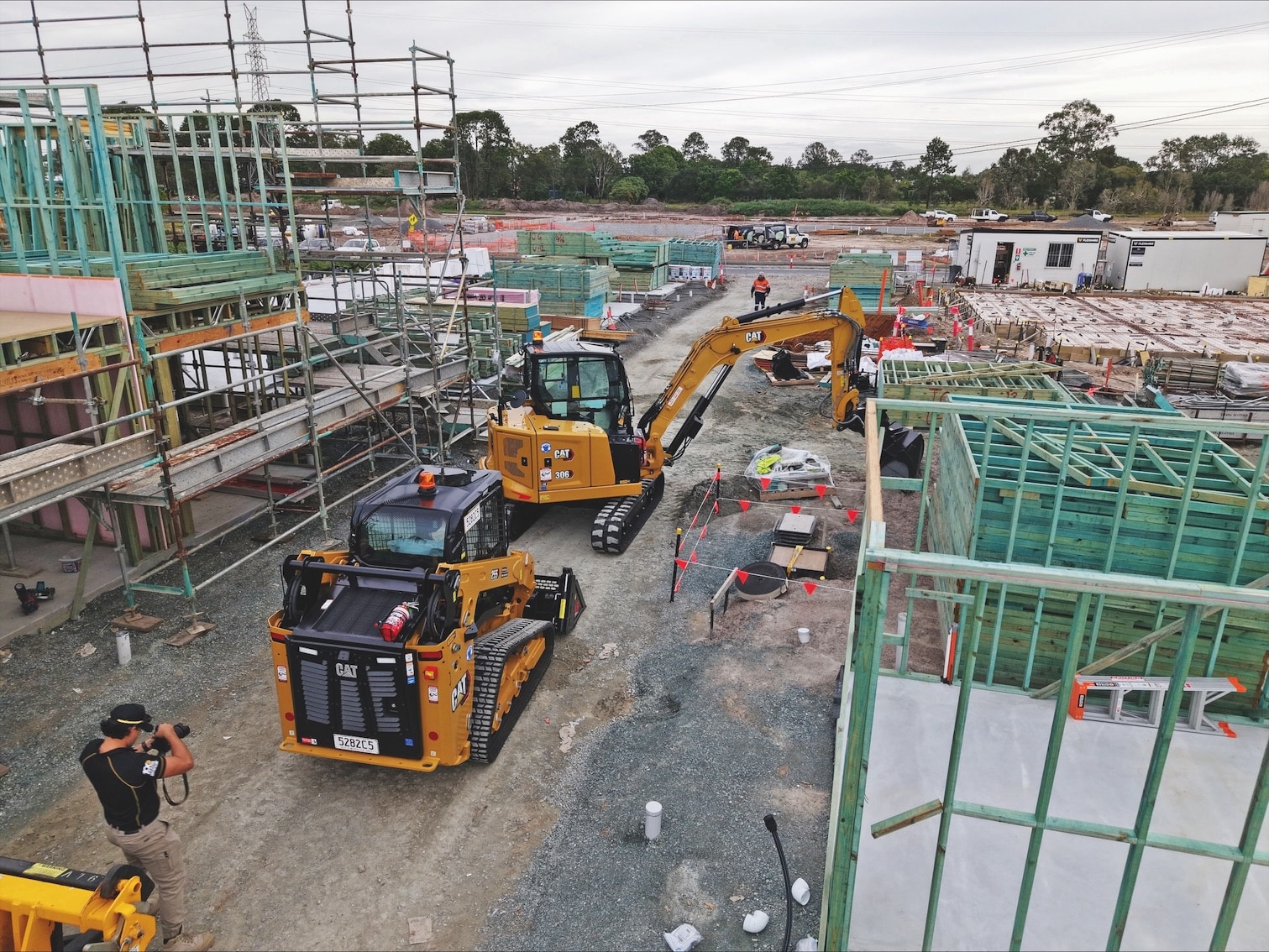
Sherlock Homes uses the Cat 255 Compact Track Loader and the Cat 306 Excavator to complete projects in house. Images: Prime Creative Media
Sherlock Homes Developments has carved out a place in South East Queensland’s residential construction landscape, with a focus on high-growth areas such as the Moreton Bay region (including Caboolture) and Beaudesert.
Since its establishment in 2016, the company has delivered affordable townhouse communities while maintaining control of the entire development process, from planning approvals through to civil works, construction, and final handover.
At the centre of the business is a philosophy that extends beyond bricks and mortar. Sherlock Homes Developments was founded by James Hamilton with the objective of addressing affordability challenges in a region grappling with population growth and housing pressures.
The company’s name itself reflects the values that underpin its operations.
According to director Jason Hunter, it’s more than a clever play on words. SHERLOCK is an acronym representing the principles that guide every project: “Safe, Honest, Efficient, Reliable, Loyal, On-Time, Care and Knowledgeable”.
“Those values are important for a business that manages projects from conception to completion,” he said.
The housing challenge
While many developers specialise in land development or construction, Sherlock Homes has adopted an integrated model that allows it to oversee every stage of a project.
“That approach gives the company greater control over quality, scheduling, and cost management, while helping maintain affordability for buyers entering the property market,” Jason said.
“The company’s mission is captured in the phrase ‘Sherlock Solves Problems’. For the business, one of the most pressing problems is the cost of living.
“Over the past decade, the Moreton Bay region has become one of Queensland’s strongest growth corridors. Improved transport links, expanding infrastructure, and population growth have increased demand for medium-density housing options that balance affordability with lifestyle.
“Sherlock Homes has responded by creating townhouse communities that maximise land use efficiency while delivering practical homes for first-home buyers, young families, and downsizers.”
Jason said the company prided itself on speed of delivery and budget friendliness. Efficiency remains one of its key strengths, allowing projects to progress quickly without compromising standards.
Several townhouse developments have helped Sherlock Homes make a mark within the region.
Among its recent projects is Stone Park Residences, a 78-townhouse build that demonstrated the company’s ability to deliver large-scale residential communities.
The company also completed Cassowary Rise, a 36-townhouse project in Caboolture. The development added housing supply to an area undergoing urban transformation. The project was designed to provide contemporary medium-density living within close proximity to schools, shopping facilities, and transport connections.
Building on those successes, Sherlock is currently delivering Goshawk Quarter, a 50-townhouse development that continues the business’ focus on attainable residential housing.
“This thriving pocket of Caboolture presents a number of logistical issues with neighbouring school vehicle and pedestrian traffic,” Jason said.
Managing those constraints safely and efficiently has required not only careful planning, but recently, investment in the right equipment.
We caught up with Sherlock Homes Civil Supervisor David Rakoci at the Goshawk site to discuss the business’ new machinery acquisitions.
What machinery? It’s elementary
Sherlock Homes identified an opportunity to increase productivity and reduce reliance on subcontractors by bringing more civil works operations in-house.
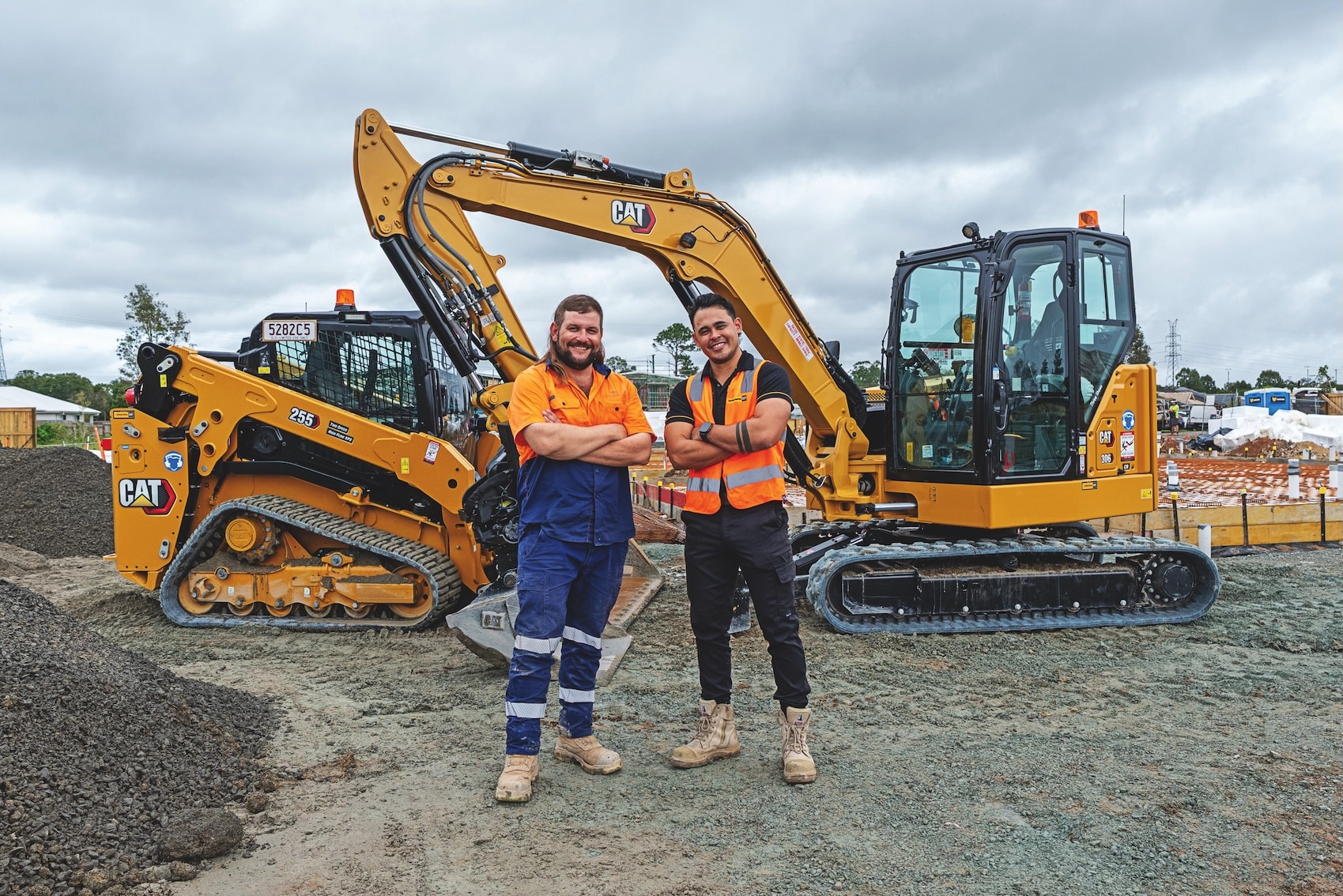
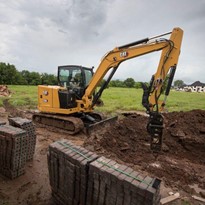
That decision led to the purchase of two Caterpillar machines that form the backbone of the company’s earthworks fleet: a Cat 255 Compact Track Loader and a Cat 306 Excavator.
The move went beyond adding equipment.
“For Sherlock, it provided greater flexibility across multiple projects while helping maintain tighter control over schedules,” David said.
“The new combo has opened opportunities to utilise every bit of space that we can and complete tasks in-house on our time frames.”
The machines were bought from dealer Hastings Deering, whose Sales Representative for new and used equipment, Robert “RJ” Lemon, was also on site.
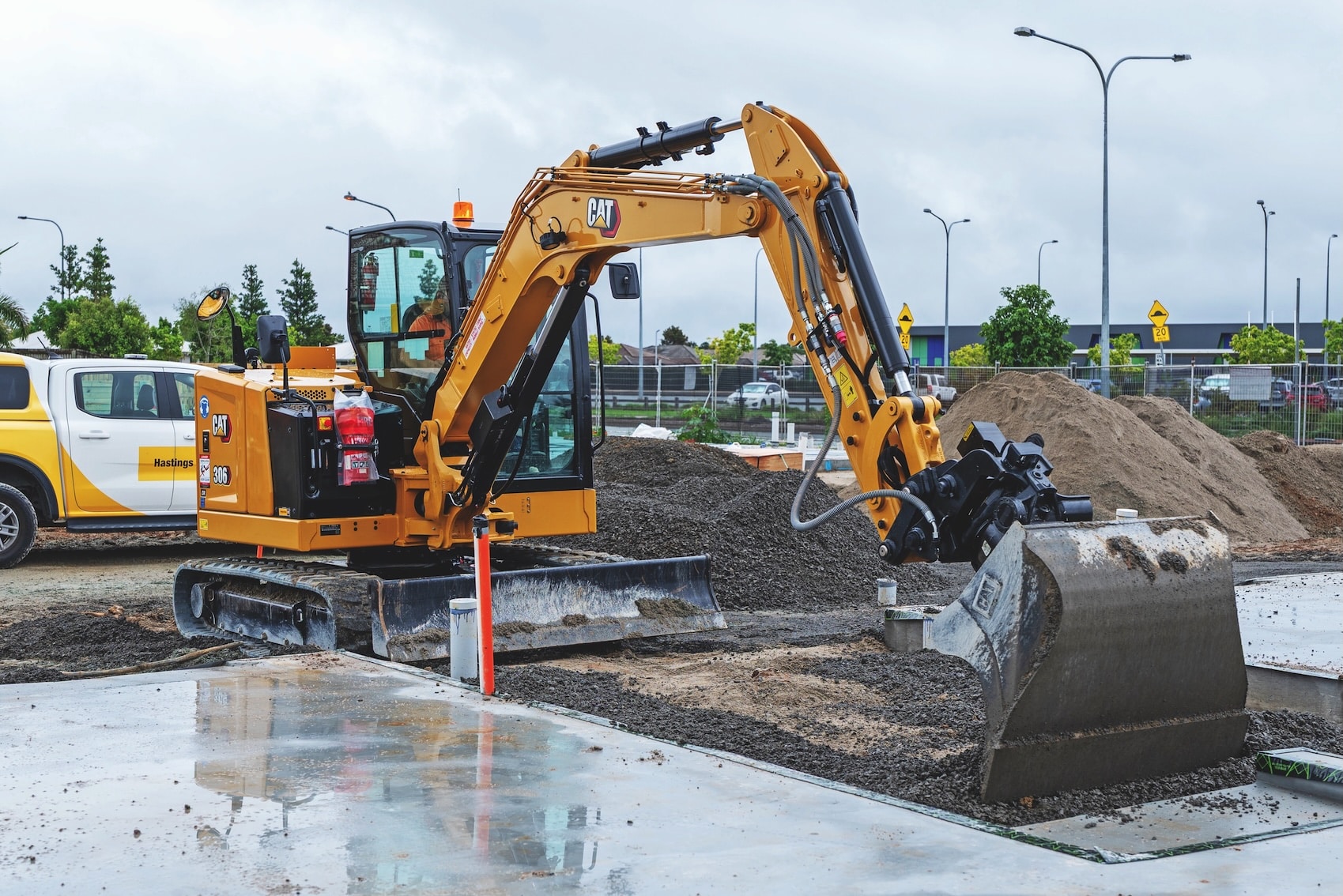
The Cat 306 excavator was selected for its ability to perform tasks on constrained residential construction sites.
Several features stood out during the purchasing process.
“The CAT 306 features that appealed were its Tiltrotator System, the fine grading system, and also the implement speed control,” David said.
The TRS increases versatility by allowing attachments to rotate and tilt, enabling operators to work at various angles without constantly repositioning the machine.
For residential developments where space is often limited and multiple trades operate simultaneously, that function can deliver productivity gains.
“The 360 hitch digger attachment means less movement of plant and access to tighter areas,” David said.
He also liked the TRS’ shaker facility, a software-driven feature that pulses the hydraulic cylinders to rapidly shake the bucket.
“I’m filling up against slabs, houses, and other builds, going around storm water pipes, cutting pads, and with the TRS, I don’t have to change the position of the digger,” David said. “With one swipe of my control, I can move the bucket wherever I want.”
The machine’s fine grading technology is valuable when preparing finished surfaces around homes and infrastructure. Precision grading reduces the need for rework and helps achieve consistent outcomes around slabs, driveways, and landscaped areas.
“Implement speed control provides operators with command over hydraulic functions, allowing attachment performance to be matched to specific applications. This results in smoother operation, increased precision, and improved efficiency,” David said.
Within Sherlock’s developments, the Cat 306 will be used for backfilling slabs, trenching services, and finishing around houses for landscaping.
Working alongside the excavator is the Cat 255 CTL, one of the manufacturer’s latest-generation compact machines.
“The CAT 255 appealed to us with its upgraded lift and push power,” David said.
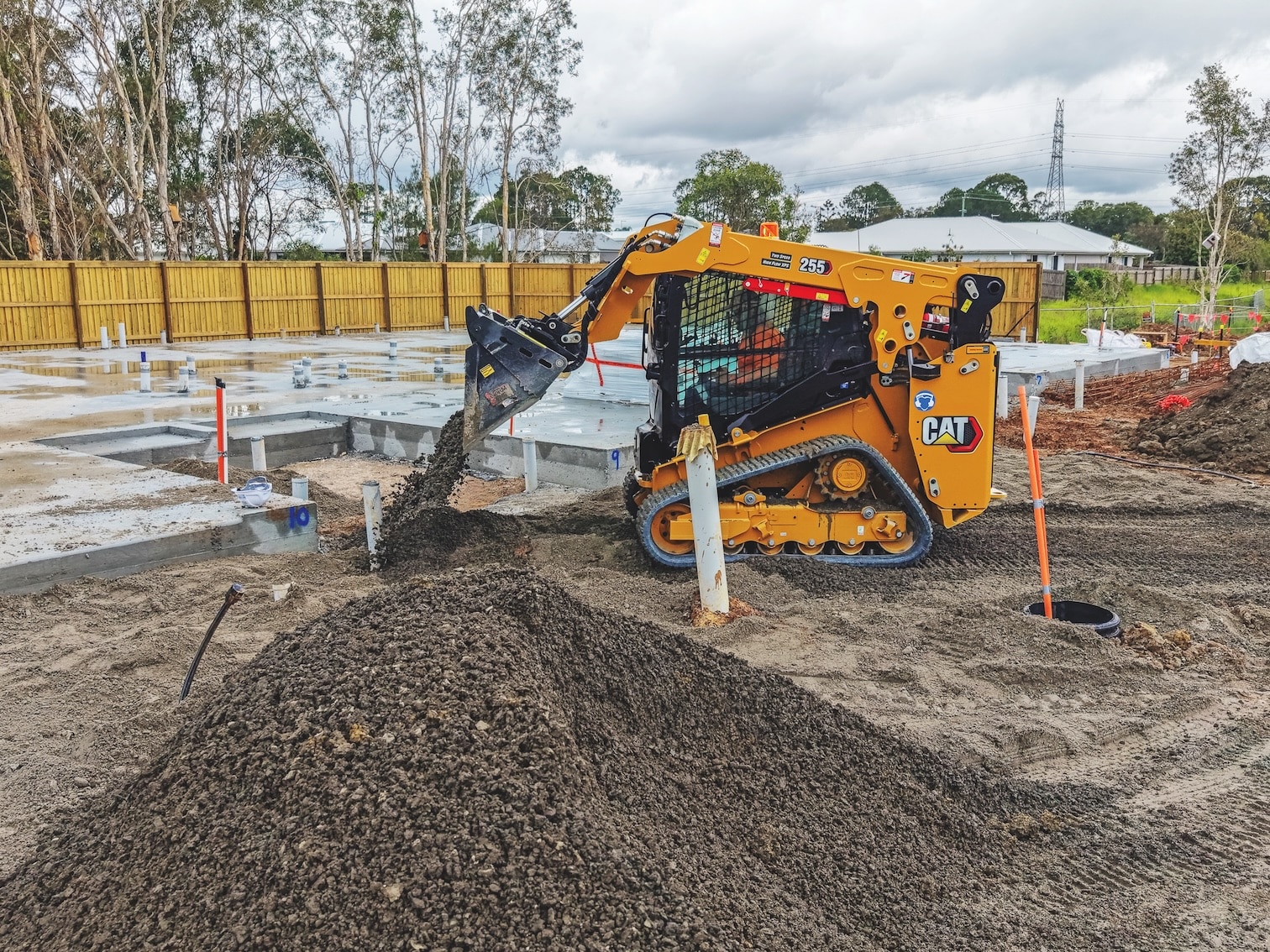
The model represents an evolution in Caterpillar’s compact track loader range. Featuring a vertical-lift design, the machine delivers increased lift height and reach, making it effective for loading, carrying, and material placement tasks. It was also redesigned to provide greater breakout force, improved stability, and enhanced operator comfort.
The machine’s torsion suspension undercarriage contributes to strong traction and flotation across varying ground conditions, making it suited to residential subdivision work where surfaces can change rapidly between excavation, preparation, and finishing stages.
David welcomed this ability of the machine to perform in harsh conditions — even as we spoke, rain was pelting down, but the 255 carried on effortlessly.
“We’ve got soft wet ground here. But the loader handles tracking through anything,” he said.
“The float control is a game-changer. If you need to get somewhere fast with a load on, the hydraulics help soften the suspension of the load.”
Powered by a Cat C2.8 turbocharged engine producing about 74 horsepower, the 255 delivers the performance required for demanding earthmoving applications while maintaining the compact dimensions necessary for residential construction sites.
For Sherlock Homes, the machine is tasked with some of the most critical stages of site preparation.
“The 255 will be used for cutting house pads, prepping, conditioning, and finishing the road surface,” David said. “It’s used as a support machine, cutting roads and keeping the job moving.”
The machine’s versatility is enhanced through the use of pallet forks, which enable it to pick up and carry a variety of building materials.
“We use the forks to move building materials around in tight locations, which is a lot more efficient than craning,” David said.
“The ease of use is great; it’s got easy maneuverability and strong pushing that lets us power through piles.”
Both machines come with VisionLink, Caterpillar’s cloud-based telematics and fleet management platform. It translates equipment data into actionable insights to help businesses maximise uptime, optimise utilisation, and lower operating costs.
“It’s so useful. It gives data for fuel burn, where the machines are located with its GPS function, how many hours they’ve done, and you can also book in servicing and order spare parts through that,” David said.
RJ reaffirmed the performance of the Cat machines.
“The Cat 306 excavator continues to be a customer favourite and is one of our top-selling models to date. It offers a spacious, well-appointed cab featuring a sleek eight-inch touchscreen monitor with integrated radio, climate control, rear-view safety camera, and more,” he said.
“Operator comfort is a standout, with a premium air-suspended seat that’s not only heated, but also designed for all-day support on the job.
“The 306 punches above its weight. It’s a versatile and well-balanced machine suited to general earthworks and running a wide range of attachments. Paired with the Cat 255 CTL, this combination delivers capability across a variety of applications.”
RJ said the CAT 255, for its part, had raised the bar in terms of performance, introducing a modern, spacious cab, improved visibility, updated displays, and enhanced operator functionality.
“The performance improvements are noticeable, with increased push power, lifting capability, and overall machine balance, without compromising efficiency. Maintenance access has also been improved, making ownership easier and more cost-effective,” he said.
“I can’t speak highly enough of these machines. Our customers are loving them, and for good reason.”
A profitable partnership
RJ said the relationship with Sherlock began after a referral from an Australian mortgage broker.
“After an initial phone conversation, I met with Jason and his team at their office in Helensvale,” he said.
“At the time, Jason and his operations team were actively exploring the market for an equipment combination that would suit their core work in residential construction and landscaping, particularly in confined and tight-access environments.
“A key part of their decision-making process was securing a reputable brand backed by reliable machinery and strong after-sales support.
“Given those requirements, Hastings Deering presented as a natural fit and a compelling solution.”
RJ said every machinery purchase should begin with a thorough and considered consultation process.
“It’s not just about supplying equipment, but about understanding the customers’ business, their day-to-day operations, and the needs of the people who will be using the machine,” he said.
“From the outset, the focus is on asking the right questions and listening carefully. What tasks will the machine perform today, and what projects are on the horizon? What site conditions need to be considered, such as access, weight restrictions, and dimensional limitations? How does safety factor into the environment, and what do operators need in terms of comfort and control?”
These conversations extend beyond specifications. Topics such as delivery time frames, machine configuration, attachments, pricing, and finance options play a role in shaping the final solution. Every detail contributes to ensuring the equipment is not only fit for purpose, but also adds value to the customer’s operation.
“At its core, the goal is simple: to make the entire process as seamless and stress-free as possible,” RJ said.
“By putting ourselves in the customer’s shoes, we can recommend machinery that aligns with their business needs and supports their long-term success.”
RJ said the relationship doesn’t end once the machine is delivered.
“At Hastings Deering, it’s about more than supplying equipment — we’re here to support it for the life of its operation,” he said.
“From ongoing maintenance to reliable service support, the commitment is to keep machines running efficiently and customers moving forward.”
Hastings Deering provides sales, rental, and parts and support services to customers across a range of industries, including mining, general construction, civil transport, commercial construction, power systems, government, primary industries, and marine sectors.
“We believe that investing in a premium product should come with a premium level of service,” RJ said.
“In my area of Cat compact and construction machinery, we take pride in our history, workforce, and dealer capability. This allows us to support our customers, ensure their equipment is well-maintained, and keep their operations running efficiently.”
RJ said with the latest machines now delivered and already making their mark on site, the next chapter of growth is under way.
“Each unit represents more than just new equipment: it’s added capability, increased efficiency, and the confidence to take on larger, more complex projects,” he said.
“As these machines are put to work, it will be exciting to see the role they play in driving productivity and supporting Sherlock’s next wave of projects. Their impact won’t just be measured in output, but in the opportunities they unlock for continued expansion.
“This milestone reinforces a strong and evolving partnership with Sherlock. As their fleet continues to grow, so too does the relationship, which is built on trust, performance, and a shared commitment to getting the job done right. Looking ahead, there’s a sense of momentum, with plenty more to achieve together.”
David said the after-sales support had definitely played a role in the purchasing decision.
“Our relationship with Hastings Deering has been great,” he said.
“I first met RJ when the machines got delivered. The handover was seamless, everything was delivered, ready to go, and ready for work.
“The service is second to none. When ordering stuff, you pretty much click your fingers and they’re here to either fix the machine or drop the parts off to fit them.”
Jason said reliable support was important for residential developers operating to tight construction schedules, where equipment downtime can have flow-on effects across multiple trades and project stages.
The experience has left a strong impression on the company.
“We will definitely be purchasing CAT machinery again,” Jason said.
View the full case study - https://www.earthmovers-magazine.com.au/sherlock-homes-case-closed-on-capability/










-205x205.jpg)
