
Key Takeaways
Start with bags per hour: throughput ÷ fill weight sets the automation level. Manufacturers quote 10 to 20 bags/h for some semi-automatic weighing stations, and up to about 20 large bags/h per operator for automated lines with accumulation conveyors.
Feed faster than your average rate: on a single station, bag changes take time out of filling, so the feed rate while filling must exceed your average throughput.
Check bulk density before choosing a bag: 1,000 kg of a product at 500 kg/m³, measured in its condition at filling, needs 2 m³ of bag volume before settling. Densification lets more fit and builds a stable bag.
Compare scale accuracy and filling accuracy separately: a precise scale can still overfill if product is in flight when the feeder stops or the cut-off is slow.
Specify dust and ergonomics: an inflatable spout seal, a dust extraction connection and an adjustable fill head do more for daily operation than frame strength alone.
Start with your product and throughput
Before contacting suppliers, settle:
the product, its bulk density at filling, flowability, and whether it is fine, dusty, abrasive, sticky or combustible
bag sizes and fill weights, now and in future
target throughput in tonnes per hour and the hours you run
whether the weight is used for trade or invoicing
how product arrives and how filled bags leave
How to size a bulk bag filler
Bags per hour = throughput ÷ fill weight.
Illustrative example: this assumes one station, no overlap between bag changes and filling, and no other stoppages.
Throughput: 10 t/h into 1,000 kg bags = 10 bags/h, so one bag every 6 minutes
Bag change: about 2 minutes to hang loops, fit the spout, release and remove
Filling window: 6 − 2 = 4 minutes, so the feed must deliver 1,000 kg in 4 minutes = 15 t/h while filling
How real conditions change the result:
Twin stations can overlap a bag change with filling, which lowers the feed rate you need.
Densification cycles, upstream interruptions and breaks raise it.
Measure or ask for realistic bag change times for your bags.
Bag volume check:
At 500 kg/m³, 1,000 kg occupies 2 m³ before settling.
Bulk density can differ between aerated product entering the bag and settled product, so use the figure that applies at filling.
Bags covered by the IEC electrostatic standard range from 0.25 to 3 m³.
Light products may need taller bags or densification to reach the target weight.
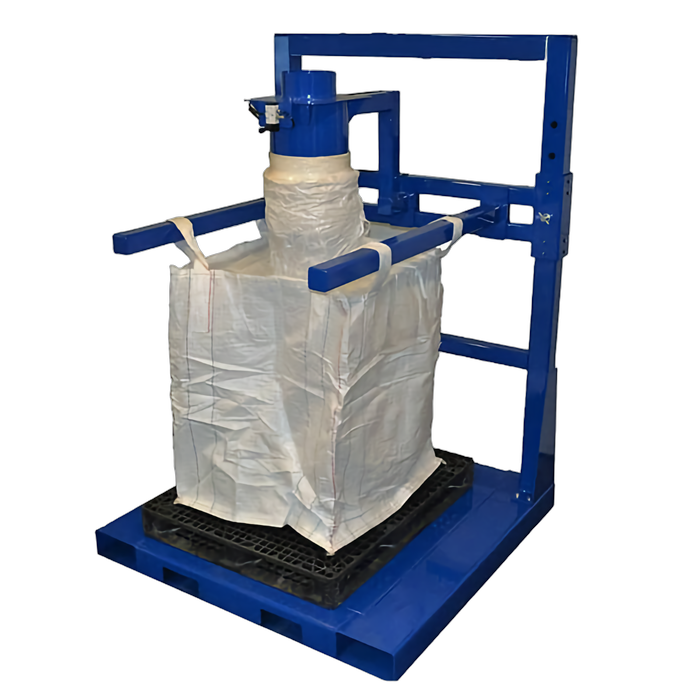
Frame configurations
Configuration | Suits | Notes |
|---|---|---|
Basic fixed frame | Occasional filling, one bag size | Low cost, but manual loop handling at height |
Height-adjustable frame or fill head | Several bag heights | Brings hooks and spout to operator reach |
Rear-post, centre-post or swing-down designs | Different access and forklift approaches | Flexicon, for example, offers twin-centrepost, swing-down and rear-post configurations |
Twin or double station | Higher throughput from one feed | Fill one bag while changing the other |
Automated line | Continuous production | Feed metering, pallet dispensing and conveyors for filled bags |
Weighing options, and scale versus filling accuracy
No weighing: fill to volume or use a separate scale. Cheapest, but least control of overfill.
Platform weighing: load cells under the bag deck, weighing bag and pallet together.
Hang-weigh: load cells carry the bag from its loops.
Coarse and fine feed: fast fill followed by a slow dribble to target, which reduces overfill.
There are two different performance measures, so compare them separately:
Scale accuracy: how closely the weighing system measures the load. National Bulk Equipment (NBE) rates a hang-weigh bulk bag filler at ±0.5% of bag weight, and claims ±0.01% for its variable container filling system. Neither source publishes the test conditions.
Filling accuracy: how close each bag ends up to its target weight. Product still falling when the feeder stops, feeder cut-off delay and settling all add overfill even when the scale is accurate.
Ask suppliers for both figures on your product at your fill rate, with the test method.
Densification
A vibrating deck settles product during filling. This lets more material fit in a given bag and produces a denser, more stable load for stacking and transport. Ask for:
whether vibration is isolated from the frame, so it doesn't transfer to surrounding equipment
the vibration cycle settings
whether densification runs during or after filling, and how it affects cycle time
Dust control
Inflatable spout seal: clamps the bag inlet tightly to prevent dust escaping during filling.
Dust extraction connection: draws displaced air from the bag.
Liner inflation and bag tensioning: a pre-forming fan and tensioning cylinder open the bag and liner fully before product enters.
Ergonomics and bag handling
Loop hooking at height is the most manual part of filling. Look for:
a fill head and hook carriage that comes down to operator reach
automatic loop release
forklift or pallet conveyor discharge
Under WHS laws, these features also reduce hazardous manual tasks.
What to send suppliers with your quote request
Product name, bulk density at filling, particle size and flow behaviour
Bag dimensions, fill weights, liner use, and bag safety rating
Throughput in t/h, shifts and days
Whether the weight is used for trade
Feed method upstream, and how filled bags leave
Available height and floor space
Dust and hazardous area information, if any
A request for fill rate, scale accuracy and expected filling accuracy on your product, with the test method
FAQs
Manual frame or weighing filler?
A frame suits low volumes with separate weighing. A weighing filler becomes worth it when measured overfill, speed or labour costs are significant.
Can one filler handle different bag sizes?
Yes, if the frame or fill head is height adjustable. Some stations are designed to adapt to bags of various sizes and dimensions. Confirm the range for your bags.
What fill rate can I expect?
It depends on product flow and bag change time. For reference, one manufacturer quotes up to 15 bags/h for its standard filler. Treat any quoted figure as product-specific.
Ready to specify? Request bulk bag filler quotes using the brief above so suppliers quote on the same basis.