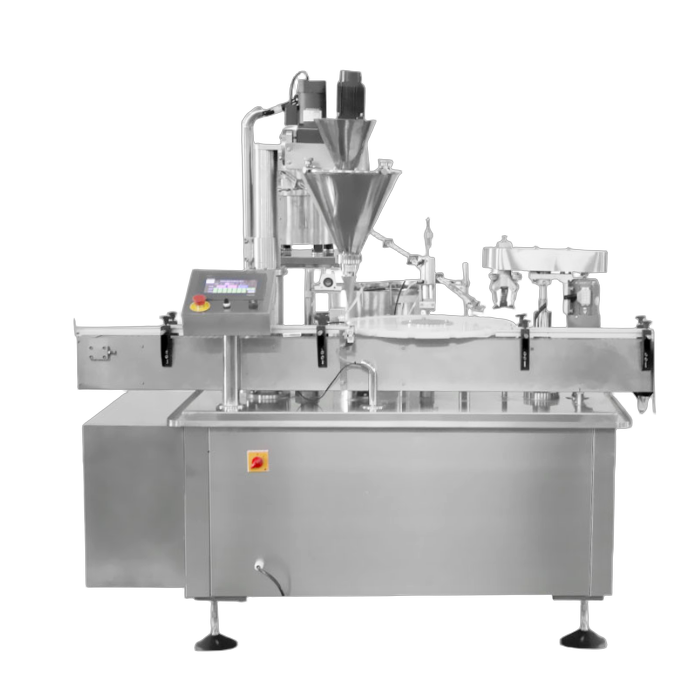

Key takeaways
- Powder filling machines range from $8,000 for a benchtop semi-automatic auger filler to $250,000+ for a fully automated net weight line.
- Fill system type (auger, net weight, volumetric cup, or vacuum) is primarily determined by your powder's flow characteristics, with container type and accuracy requirements as secondary factors.
- Fill system type (auger, net weight, volumetric cup, or vacuum) is primarily determined by your powder's flow characteristics, with container type and accuracy requirements as secondary factors.
- Auger fillers suit fine, non-free-flowing powders (protein, flour, spice, pharma) - accuracy to ±0.5% is achievable under controlled conditions with servo control, with typical production ranges of ±0.5–1.5%.
- Net weight fillers are typically preferred for sold-by-weight consumer goods requiring NMI trade measurement compliance, as they reduce giveaway risk and simplify compliance - they cost 30-50% more than equivalent auger systems.
-
Food and pharmaceutical applications require FSANZ-compliant hygiene design, with AISI 316L stainless contact surfaces commonly specified for high-hygiene or corrosive environments, while AISI 304 remains acceptable for many standard food applications.
Throughput ranges from 5-20 fills/min (single-head semi-auto) to 60-120 fills/min (multi-head fully automatic) - always confirm at your actual fill weight. - Lead times for imported systems typically run 10-20 weeks into Australia - budget installation, commissioning, and operator training as separate line items.
- All powder filling machinery is classified as plant under the WHS Act 2011 - PCBU obligations for risk assessment, guarding, and maintenance records apply from commissioning.
Why Australian manufacturers are investing in powder filling equipment
Powder filling machines automate the volumetric or gravimetric dispensing of dry powders into containers, bags, or pouches - and demand across Australian food, nutraceutical, agricultural, and chemical manufacturing has accelerated as labour costs climb and retailer weight-compliance requirements tighten. The shift to automated filling is driven as much by fill accuracy and batch traceability requirements as by throughput. For a view of how powder filling integrates with your downstream packaging format, the VFFS vs pre-made pouch machine comparison guide covers bag format decisions that directly affect fill system selection.
This guide is for production managers and procurement leads evaluating a first powder filling system or upgrading an existing line. It covers configuration selection, key specifications, 2026 pricing, asset planning, and supplier evaluation. Operations using powder filling equipment in Australia include:
- Food and beverage manufacturers - protein powders, flour, spices, coffee, sugar, salt, and dairy powders
- Nutraceutical and supplement producers - vitamins, pre-workouts, meal replacements, and herbal blends
- Pharmaceutical manufacturers and compounding pharmacies - APIs, excipients, and dispensed powders
- Agricultural chemical and fertiliser producers - fungicides, herbicides, and trace element blends
- Contract packagers servicing multiple SKUs across food, health, and industrial categories
Choose your fill system configuration
Before costing anything, confirm which fill system suits your product and output requirements. Your choice here sets your price bracket, your accuracy ceiling, and most of the downstream specifications that follow.
System Type | Fill Range | Best For |
|---|---|---|
Auger filler |
1g - 5kg |
Fine, non-free-flowing powders - protein, flour, spice, pharma |
Net weight / gross weight filler |
100g - 50kg |
Free-flowing bulk products, variable density, legal-for-trade |
Volumetric cup filler |
5g - 2kg |
Free-flowing granules with consistent bulk density - sugar, salt, grain |
Vacuum / piston filler |
1g - 500g |
Aerated, ultra-fine, or hazardous powders requiring contained transfer |
Choose an auger filler if your product is a fine or cohesive powder that bridges, aerates, or clumps under gravity. Auger systems use a rotating screw to deliver consistent fill volumes regardless of density variation - the standard configuration for protein powder, flour, spice blends, and pharmaceutical powders in Australia.
Choose a net weight or gross weight system if your product is free-flowing, your fill weights are 500g or above, and NMI trade measurement compliance applies. Both cost more than equivalent auger systems but are the correct specification for bulk food and agricultural applications.
Once you have confirmed your fill system type and throughput requirements, get quotes for powder filling machines on IndustrySearch to compare options from verified Australian suppliers.
Evaluate the key specifications
With your configuration confirmed, these are the specifications that determine whether a given model fits your production line and regulatory environment.
Specification | Typical Range | Buyer Consideration |
|---|---|---|
Fill weight range |
1g - 50kg |
Confirm the machine covers your full SKU range - tooling changes between weight ranges add cost and downtime |
Fill accuracy |
±0.5% - ±2% |
Food and pharma require ±1% or better; ±0.5% demands servo-controlled dosing and inline verification |
Throughput (fills/min) |
5 - 120 fills/min |
Always confirm at your actual fill weight - headline speed figures are measured at light fill weights |
Hopper capacity |
5L - 500L |
Undersized hoppers cause refill interruptions on high-speed lines - match to your shift production volume |
Contact surface material |
AISI 304 or AISI 316L |
316L mandatory for food, pharma, and chemical applications - confirm via material certificates |
CIP / WIP compatibility |
Manual, semi-auto, full CIP |
Full CIP adds $15,000-$40,000 to capital cost but eliminates changeover labour in multi-product environments |
Container compatibility |
Bags, pouches, cans, jars, tubs |
Confirm fill head clearance against your container opening and that infeed conveyor geometry matches |
Understand the full cost breakdown (2026 prices)
Purchase price is only part of the picture - most cost models that get rejected at approval stage have missed the running cost layer. Here is the full breakdown.
Category | Price Range (AUD) | Typical Configuration |
|---|---|---|
Entry semi-automatic auger filler |
$8,000 - $18,000 |
Benchtop single-head, manual container placement, 5-15 fills/min, 304 SS |
Mid-range automatic auger filler |
$25,000 - $65,000 |
Single-head with auto conveyor, servo-controlled, 20-40 fills/min, 316L SS |
High-spec multi-head auger system |
$80,000 - $150,000 |
Twin or quad-head, full automation, CIP, 60-120 fills/min, touchscreen PLC |
Net weight filling line |
$45,000 - $250,000+ |
Semi to fully automatic, NMI-verified load cells, integrated reject system |
Used / refurbished system |
$5,000 - $40,000 |
Inspect auger tooling, seals, control board, and calibration records before purchase |
Annual maintenance |
$2,500 - $8,000 |
Seals, auger tooling, bearings, calibration, and annual PM service |
Auger and tube tooling set |
$800 - $3,500 per set |
One set required per active SKU - high SKU counts are the largest TCO variable |
TCO over five years on a mid-range automatic auger filler typically runs $45,000-$90,000 all-in once maintenance, tooling, and consumables are factored in. Seal failures and auger shaft wear drive most unscheduled stoppages - parts sourced from overseas carry 3-7 day lead times. WA and QLD buyers should confirm local service coverage before shortlisting, as NSW and VIC have denser technician networks for major European and Japanese brands. For a mid-range automatic auger system at $25,000-$65,000, get quotes for powder filling machines to compare supplier configurations and service coverage before approval.
Plan the asset - depreciation and financing
The ATO effective life for powder filling machinery is 10 years - diminishing value rate 20%, prime cost rate 10%. The instant asset write-off threshold for 2025-26 is $20,000; entry semi-automatic systems fall within this and can be fully expensed in the year of purchase. Residual value at 8-10 years is typically 10-20% of purchase price for well-maintained systems with documented service records.
Hire-to-own and operating lease structures are available from approximately $650/month for a $25,000 system over 48 months - appropriate where volume is unproven or capital preservation is a priority during commissioning. The filling machine price guide covers financing structures across filling equipment categories in more detail.
Evaluate suppliers
You are ready to go to market. Use this checklist to assess each supplier against the same criteria.
Factor | What to Ask |
|---|---|
Product validation |
Will you conduct a trial fill with my actual product before I commit to purchase? |
Fill accuracy guarantee |
What accuracy is guaranteed at my target fill weight and under what conditions? |
Tooling compatibility |
How many SKUs can one machine handle without a tooling change, and what does each set cost? |
Contact surface certification |
Can you provide material certificates confirming AISI 316L for all product-contact components? |
Australian compliance |
Does the machine include an Australian Declaration of Conformity meeting AS 4024 machinery safety standards? |
Service network |
Do you have a technician based in my state, or is service dispatched from interstate or overseas? |
Parts availability |
Are wear parts (seals, auger flights, bearings) held in Australian stock - and what is your standard lead time? |
Installation and commissioning |
Is installation and operator training included in the quoted price or charged separately? |
Warranty terms |
What is the warranty period and does it cover labour as well as parts? |
Upgrade path |
Can the machine add heads or integrate with a checkweigher as volume grows? |
Lead time |
What is the current lead time from order to commissioning, and what are the key milestones? |
Frequently asked questions
What does a powder filling machine cost in Australia in 2026?
Entry semi-automatic auger fillers start at $8,000-$18,000; fully automatic multi-head systems run $80,000-$150,000+, with net weight lines reaching $250,000 or above. Budget a further 15-20% of machine cost for installation, commissioning, and initial tooling.
At what production volume does automated powder filling justify the capital over manual filling?
For most food and nutraceutical operations the crossover is approximately 200-400 units per shift - above this a fully automatic system typically recovers capital within 12-18 months through labour savings and reduced give-away. A mid-range system at $45,000 replaces approximately 1.5 FTE of manual filling labour at current award rates.
When should i choose an auger filler vs a net weight filler for compliance and fill accuracy?
Choose an auger filler for fine, consistent-density powders where volumetric accuracy at ±0.5-1% is sufficient - protein, flour, spice, and pharmaceutical applications. Choose a net weight filler when NMI trade measurement compliance is required for sold-by-weight consumer goods; it costs 30-50% more but is the only legally compliant option for those applications.
What compliance requirements apply to powder filling machines in Australia?
All powder filling machinery is plant under the WHS Act 2011 - PCBU obligations require risk assessment, AS 4024 guarding, and a maintenance register from commissioning. Food applications require FSANZ-aligned product-contact and hygiene design standards; pharmaceutical installations may also require GMP-aligned validation depending on use case.
Should i buy new or used powder filling equipment?
Used systems at $5,000-$40,000 suit non-food applications with stable SKU counts and internal maintenance capability - inspect auger tooling, seal integrity, and calibration records before purchase. For food, pharma, or nutraceutical lines, retrofit hygiene upgrades on used systems frequently approach the cost of a new entry-level machine, making new the correct specification.
Summary
- Fill system type is determined by product flow characteristics - auger for fine cohesive powders, net weight for free-flowing bulk and legal-for-trade applications
- Contact surface specification (316L for food/pharma, 304 for agricultural/industrial) must be confirmed via material certificates, not supplier claims
- Throughput speed must be quoted at your actual fill weight - headline fills/min figures are not comparable across machines without knowing the fill weight used
- Five-year TCO includes tooling sets per SKU and annual maintenance at $2,500-$8,000 - parts availability and local service coverage are the biggest cost variables in Australia
- Require a product trial fill before committing - bridging behaviour and fill accuracy cannot be predicted without physical testing on your actual powder
Don't waste time contacting suppliers individually. IndustrySearch gives you direct access to verified Australian powder filling machine suppliers - where industrial buyers request and compare multiple quotes so they can buy with confidence.
- Get quotes for powder filling machines - contact multiple verified suppliers with a single enquiry
- Compare models - filter by fill system type, capacity, and region
- Contact suppliers directly - speak to specialists who service your state
→ Get and compare powder filling machine quotes now → https://www.industrysearch.com.au/buy/powder-filling-machine