

USA-based fabricators have been affected by such international factors for a
little longer than companies in the Australasia region, hence some have been able to maneuvre with maturity out of challenging work zones. Sheetmetal machinery supplier, Maxitec, has been at the forefront in managing solutions for companies looking to take the next step against these types of tests and points to a particular example in the USA, that of King Electric, a heater manufacturer.
“The plight of and subsequent action taken by King Electric has such strong
parallels to what many sheetmetal fabricators in Australia are now beginning to face,” said Sales and Marketing Manager of Maxitec, Mr Andrew Bentrup. "With the low-cost labour option dangled by China, there is always a temptation to import cheaper product rather than undertake fabrication here. Yet that opens a new field of issues such as quality assurance problems and the ever-present prospect for transport delays, which can kill profit margins and compromise contractual agreements."
King Electric was facing two major challenges: low-cost competition from
China, and even more threatening, an emerging customer service backlog
created by old fabricating equipment and outdated manufacturing strategies and techniques.
Old Equipment: In 2006, King Electric took a hard look the competitive pressures in the marketplace that were beginning to adversely affect its operation. Many of its competitors were starting to import their products from China. The company’s management even took a two-week industry tour of that country and spoke to many Chinese manufacturers, trying to determine if there were benefits in giving up the manufacturing operation and begin importing its products.
“Management didn’t see importing as a viable answer and turned to evaluating an alternate strategy - to modernise its existing facility. But significantly, management chose to select a new manufacturing strategy before selecting any new equipment,” said Mr Bentrup. “The train of thought was that lean manufacturing comes down to eliminating waste, and all its machinery investments would be based on that premise.”
At the time, King Electric’s metalworking equipment consisted of hard tool
punch presses, press brakes, and old mechanical turret punch presses. One of its problems was that it was a batch run oriented shop. If King Electric had 500 heaters to make, there would be several different batch operations in progress to complete the job. The process lacked coordination in each batch operation. In some cases 500 parts were made…in other areas 5,000 parts were produced.
There were often part shortages in one stage of production and surpluses in
another, which resulted in bottlenecks that translated into long lead times and n increasing number of frustrated customers. The old mechanical turret punch press that was in use could not utilise the latest nesting software or advanced tooling on the market, resulting in wasted steps of production. First, the sheet had to be blanked to size on a shear. Then the blank was moved to the turret for fabrication, and again moved back to shear to cut out the part.
They started purchasing pre-sheared blanks, but now were paying a premium for steel. Often, there were nearly 35 different sizes of pre-sheared blanks at
various areas throughout the stop. The company was wasting production time and money by the process of shear, punch, and shear the part out. Work in
process was all over the shop floor, and they were paying a premium for the
pre-sheared blanks. In addition, management was also outsourcing $250,000 to job shops in order to keep up with production demands.
In searching for a new turret punch press, King Electric was looking for a
machine that could utilise advanced tooling and software. After an extensive
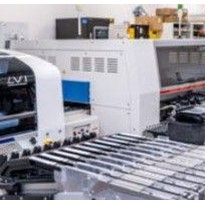
search, the company chose the Finn-Power C5 Compact Express. The unit’s loading/ unloading solution automation. The unit’s loading/unloading solution utilises the space above and below the machine, requiring only slightly more space than a turret punch press. It is fast, with simultaneous loading and unloading during processing, accurate, and it does not limit easy manual operation.
The 20-station, 33-ton C5 hydraulic turret punch press has a maximum sheet
capacity of 50”x100” and is available with either Siemens of Fanuc controls.
Tooling flexibility is important to King Electric. Up to 10 auto-index and
Multi-Tool holders may be installed in a Finn-Power turret. King Electric has
five auto-index stations, three up =forming stations, and three Multi-Tool
stations in the C5, Unique to the C5 turret punch press, full tonnage index able up forming allows complex forming operations to be made quickly by using a single forming tool.
Upforming: One of the key parts to King Electric’s manufacturing operation is the ability to make louvers. Many of the louvers formed are bent to a full 90 degrees to achieve the least resistance of air flow, with the hot air coming out of the heater. This creates a very high form up to 3/8” high. Finn-Power’s upforming feature provides a precise process for knock-outs, louvers, and other forming; Finn-Power resolved the conventional problem of the die height impeding free sheet movement. Finn-Power’s design allows forming heights up to 16mm (0.62”).
Before and After: One challenge for King Electric was a grille which has a louver at 54 degrees for the intake air and a louver at 90 degrees for the discharge air. On the Finn-Power C5, King Electric is able to make these louvers in a single operation on a nested sheet, which allows the company to produce 24 parts on a 4’x8’ sheet. Material utilisation has increased dramatically to approximately 85%. The full-sized sheets run negate the premium for pre-sheared blanks.
Lights Out Manufacturing: The C5 compact Express runs 40/week and often is performing lights out production for jobs running as long as 16-20 hours. The C5 Compact Express hooked up with a web cam so that the machine can be monitored at night. Lead times that were 10-12 weeks are now 2-3 weeks. Today, King Electric is building to order and producing in real time.
-160x160-state_article-rel-cat.png)
-160x160-state_article-rel-cat.png)