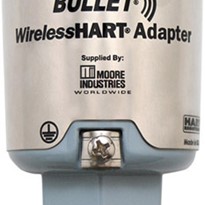
Real-time data acquisition goes WirelessHART at a major US power company. The BULLET proves a budget saver – it's the only network adapter with multi-drop support for up to eight devices. A major power company in the United States serves 7.2 million customers with approximately 57,700 megawatts of generating capacity. In order to better serve its customers, an internal SWAT team called Performance Testing is dedicated to stamping out inefficiency.
Managed by Dick Fletcher, Performance Testing consists of six engineers and technicians who keep plant equipment and systems running smoothly by travelling from plant to plant, testing, troubleshooting and verifying performance standards on new and upgraded equipment.
Performance Testing serves the utility's 35,000 MW of fossil generation located in six states across the Southeast and Midwest that reach the company's 7.2 million customers. The group often splits into teams of two to more efficiently perform testing that supplements each plant's individual efforts to ensure peak efficiency and output.
Testing in the field requires portable data acquisition systems that can collect data from multiple process instruments located throughout a facility. The test typically records time-stamped data through a gateway and into a spreadsheet-type application on a laptop PC. Test equipment must be portable and flexible enough to operate with a fluctuating number of instruments and scan rates.
The problem with hard wires
Performance Testing maintains more than 250 transmitters primarily used for temperature and pressure measurements along with some flow measurements. These transmitters have been traditionally hard-wired to HART multiplexers with long cables to accommodate runs across facilities to conduct tests; in some cases, this means running cables over streets.
Testing required time-consuming set-up and tear-down that could last for days and involved hard-wired network multiplexers that would occasionally fail from wear and tear. Problems with wiring damage also occurred as cables were reused from site to site to connect up to 100 instruments. The advent of the WirelessHART protocol and the commercial availability of network WirelessHART adapters conforming to the standard allowed the group to install a new wireless system that would replace its aging test equipment and streamline the testing process (see Figure 1).
"Both traveling test groups had a major investment in our existing HART Smart Transmitters," Fletcher said.
"The logical thing to do was get a common data acquisition system to be shared across the system by Performance Testing."
Fletcher set short-term goals for a new system. It needed to be flexible enough to handle a variety of instruments interfacing with a variety of protocols, with an emphasis on high-accuracy pressure and temperature transmitters. The system also had to be easy to configure since every plant requires a different configuration.
He also set long-term goals to use the system to both broaden the scope of testing and achieve a remote data flow over the corporate wide-area network (WAN) for remote testing and analysis. But the group first had to establish a new system as a proof of concept.