
Key Takeaways
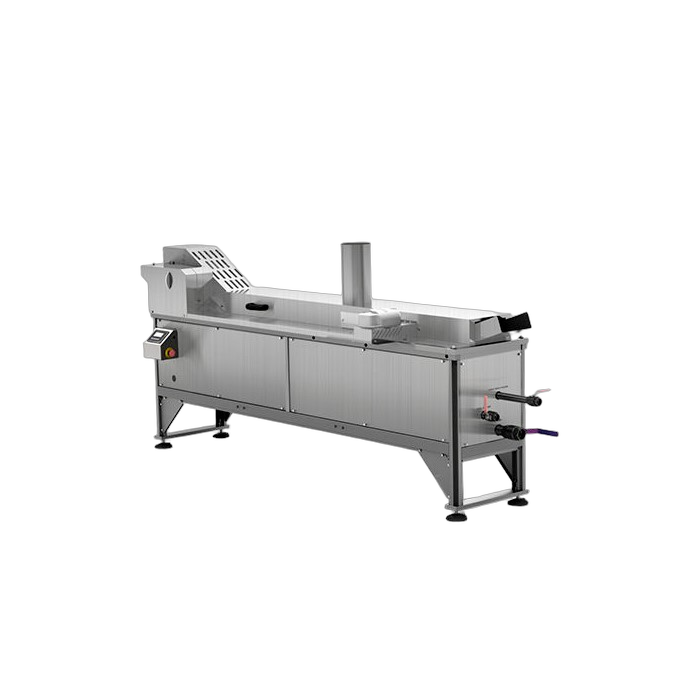
Which suits what: continuous fryers suit steady, high-volume runs of a few products. Batch fryers still win for kettle-style texture, short runs and frequent recipe changes.
Oil turnover drives oil quality: published industrial frying guidance puts typical turnover at about 5 to 10 hours, depending on product, temperature, fryer design and operating conditions.
Bigger is not safer: an oversized continuous fryer running at low volume holds too much oil for its output, which slows turnover and shortens oil life.
Size for real utilisation: start-ups, changeovers and stoppages usually limit a fryer to 80 to 90% of design capacity.
Do the maths first: calculate oil turnover at your actual volume before requesting quotes.
The short answer
Switch to a continuous fryer when your volume is steady enough to keep the fryer near full capacity. If your output is small, seasonal, or spread across many recipes, a batch fryer is often the better choice. The deciding factor is rarely the fryer's headline capacity: it is whether your production keeps the oil turning over fast enough to stay in good condition.
TNA's processing specialists say batch frying suits products that need traditional kettle-style texture, controlled batch conditions and strong colour and crunch, while continuous frying fits high-volume production where steady flow is the priority.
How batch and continuous frying differ
Factor | Batch fryer | Continuous fryer |
|---|---|---|
Loading | Product loaded and unloaded per batch | Product enters one end and exits the other on a conveyor |
Typical capacity | About 5 to 50 kg per batch | Hundreds to thousands of kg per hour |
Oil turnover | Often much slower. One potato frying equipment maker cites 35 to 40 hours for traditional batch chip fryers | Industrial guidance puts typical turnover at about 5 to 10 hours, depending on operating conditions |
Temperature control | Oil temperature drops when each batch goes in | Oil level and frying temperature held automatically |
Flexibility | Easy recipe and product changes | Best on long runs of a few products |
Floor space | Compact | Needs more space, plus infeed and outfeed |
Signs you have outgrown batch frying
Oil is discarded on a schedule because it degrades before it is used up.
Colour and texture vary between batches or operators.
Staff time is spent loading, timing and unloading rather than on value-adding work.
The fryer is the bottleneck between prep and packing.
Customers or retailers are asking for tighter consistency or more volume.
When batch frying is still the better choice
You make kettle-style or hand-cooked products where batch texture is the selling point.
You run many short recipes per shift.
Volume is too low to keep a continuous fryer near capacity.
Floor space or utilities cannot support a longer machine.
There is also a middle path. At least one manufacturer offers a dual-function fryer that produces both true batch-fried chips and standard chips in the same pan.
The oil turnover test: run this before you buy
Oil turnover is how many hours it takes for the oil carried out in your product to equal the oil in the system. Shorter is generally better, because fresh top-up oil continually dilutes degraded oil.
Theoretical turnover in hours = oil in the fryer ÷ (finished product per hour × oil content of the finished product).
Worked example:
Fryer system oil: 400 kg
Output: 200 kg/h of finished product at 25% oil content, so 50 kg of oil leaves in product each hour
Theoretical turnover: 400 ÷ 50 = 8 hours
Adjusted for real operation: start-up, shutdown, changeovers and stoppages typically limit utilisation to 80 to 90%, so actual turnover is closer to 9 to 10 hours
How to read the result: compare it with published benchmarks, and treat them as guides rather than hard limits.
Industrial fryer guidance puts typical turnover at about 5 to 10 hours.
One review of frying oils recommends keeping continuous industrial frying under about 10 to 12 hours to maintain oil quality.
Food-service research finds batch fryers struggle to maintain oil quality at 20 hours or more. That figure comes from food-service fryers, not industrial lines.
Your own limits should come from oil quality testing on your product. If your planned volume pushes turnover well beyond these ranges, the fryer may be too large for your production. Buying an oversized fryer for future growth increases system oil volume, and if product volume stays low relative to that oil, turnover suffers and oil life shortens.
What switching changes on your site
Layout: the fryer needs space plus infeed from prep and outfeed to cooling, seasoning or packing.
Utilities: higher continuous gas or electrical load, and possible gas appliance approval depending on the appliance and your state.
Exhaust and fire protection: sized for continuous operation.
Cleaning: scheduled boil-outs or CIP replace end-of-day manual cleaning.
Skills: operators manage belt speed, temperature and oil quality rather than timing batches.
FAQs
Can a continuous fryer make kettle-style chips?
Not usually with the same texture. Dual-function and specialised designs exist, so ask suppliers for a product trial.
Can one continuous fryer run several products?
Yes, if their fry times and temperatures sit within the fryer's belt speed and temperature range. Frequent changeovers reduce utilisation, which lengthens oil turnover.
What output justifies a continuous fryer?
There is no fixed threshold. Run the turnover test at your realistic average volume, then add labour time saved and consistency gains.
Does a continuous fryer reduce oil costs?
It can reduce discarded oil when it runs near capacity, because faster turnover keeps the oil usable for longer. Oil absorbed into product stays the same.
Weighing the switch? Compare continuous fryer suppliers and ask each one for an oil volume and turnover estimate at your output.