
Key Takeaways
No reliable Australian price list exists: most suppliers quote per project. The clearest public benchmark is a new compact European continuous fryer advertised ex-works at about A$19,500 at mid-October 2026 exchange rates, before freight, GST, compliance and installation.
Price follows scope: cook area, conveyor configuration, heating system and filtration drive the quote more than the brand does.
Used machines vary widely: used continuous belt fryers advertised worldwide ranged from about US$2,400 to US$287,000 when checked in October 2026.
Budget for site work separately: gas or electrical work, exhaust, fire protection and commissioning are rarely in the machine price.
Tax treatment: the $20,000 instant asset write-off is now permanent, but most continuous fryers cost more than that. Dearer assets go into the small business pool at 15% in year one and 30% after that.
How much does a continuous fryer cost in Australia?
There is no published Australian price list for continuous fryers. Suppliers price them from your product, output and site. A compact unit and a full industrial frying line both fall under the same name, so any single "average price" figure is misleading.
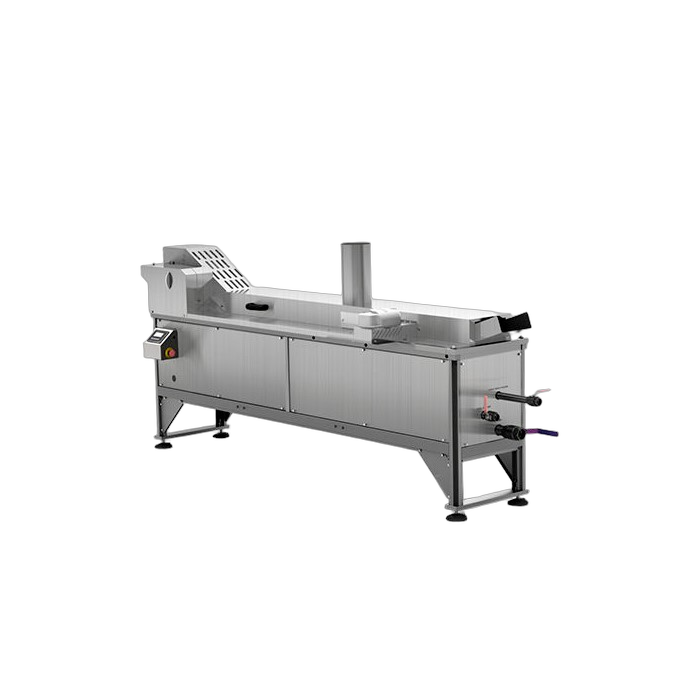
Advertised prices give a starting point. A new 2026 compact continuous fryer from a Spanish manufacturer is listed ex-works plus VAT. At the mid-October 2026 rate of about A$1.60 per euro, that is roughly A$19,500 before freight, GST, Australian compliance work and installation. Treat it as a floor for comparison, not an Australian landed price.
Tier | Typical buyer | What you get | Price guide |
|---|---|---|---|
Compact electric conveyor fryer | Caterers, central kitchens, small manufacturers | Narrow mesh belt, short pan, thermostat, variable belt speed | Advertised overseas from about A$19,000 ex-works. Australian installed cost needs local quotes |
Mid-scale multi-product fryer | Meat, poultry, seafood and ready-meal producers | Wider belt, hold-down belt, built-in filtration, PLC controls | Quote-based: compare at least three like-for-like quotes |
Industrial frying system | High-volume chip, snack and coated-product lines | External heat exchanger, continuous filtration, oil tanks, cleaning-in-place (CIP) | Priced per project, including integration |
Suppliers in Australia include Heat and Control, TNA, JBT, GEA, Pacific Food Machinery, Symetec, Baketec and Skanos (Kuppersbusch). Most quote only after reviewing your product and output.
What drives the quoted price?
Cook area: belt width multiplied by pan length sets output, and it is the biggest single price lever.
Conveyor configuration: hold-down belts, submergers, double belts and mesh gaps change both the build and the oil volume. One used gas continuous fryer on the Australian market holds 251 L of oil with a 20 mm mesh gap and 370 L with a 60 mm gap.
Heating system: electric elements, direct gas firing, or an external heat exchanger using thermal oil or steam. Each option carries a different equipment and installation cost.
Oil management: continuous filtration, automatic top-up, holding tanks and fines removal.
Controls and build: PLC recipe control, data logging, stainless washdown construction and hood lifts.
Costs that usually sit outside the machine price
Freight and GST: sea freight, port and customs charges, and 10% GST. GST is claimable if you are registered.
Gas approval: large gas fryers in industrial premises may be classified as Type B appliances, depending on the appliance and your state. In Victoria, a Type B appliance needs Energy Safe acceptance before gas is connected, and the gas distributor needs that acceptance before it will supply gas. Ask suppliers whether their quote covers this work.
Electrical capacity: electric fryers draw significant three-phase load. Even a small used unit with a 250 mm belt is rated at 45 kW, which may need a switchboard or supply upgrade.
Exhaust and fire protection: AS 3772 sets requirements for pre-engineered fire protection systems on relevant cooking equipment, and its scope covers grease removal devices, hoods, exhaust ducts and filters. Ask your fire protection designer and insurer early, because their requirements can change the layout.
Commissioning: installation, product trials, operator training and an initial spare parts kit.
What does a continuous fryer cost to run?
In chip and fry production, oil is often the largest consumable cost. There are two kinds of oil spend:
Oil absorbed by product: this is a recipe cost you pay whatever fryer you use.
Oil you discard: this is the cost good fryer selection reduces. Systems that hold less oil relative to output turn their oil over faster, so less of it degrades to the point of disposal. The batch vs continuous guide shows how to calculate this.
Other running costs:
Energy: gas or electricity for heating.
Cleaning time: boil-outs and CIP downtime.
Wear parts: belts, chains, bearings and pumps.
Service: scheduled visits and repairs.
Ask each supplier for expected oil volume, energy consumption at your output, and the annual wear parts list.
Should you buy new or used?
Used fryers can cut the upfront cost sharply. When checked in October 2026, one global marketplace listed 213 used continuous belt fryers priced from US$2,400 to US$286,900. Listings and prices change frequently.
The risks are specific:
Parts: availability for older models.
Gas compliance: a used gas fryer may still need approval for your site.
Fit: a machine sized for someone else's product.
Ask for service history, a list of replaced components, and whether the original manufacturer still supports the model in Australia.
How to compare continuous fryer quotes like for like
Check that every quote states:
belt width, pan length, oil volume and rated output for your product
heating type, and gas consumption in MJ/h or electrical load in kW
what filtration, oil top-up and fines removal are included
delivery terms: ex-works, landed, or installed
who handles gas or electrical approvals
commissioning, training and product trial inclusions
warranty length, local service location and response times
recommended spare parts and their prices
FAQs
Can I claim a continuous fryer under the instant asset write-off?
Only if it costs less than $20,000. The permanent $20,000 threshold from 1 July 2026 is now law. It applies per asset for businesses with aggregated turnover under $10 million. Assets costing $20,000 or more can go into the small business pool, depreciated at 15% in the first year and 30% each year after. Confirm your position with your accountant.
Is a cheap imported continuous fryer worth it?
It can be for simple products at modest volumes. Before comparing an overseas list price with a local quote, add freight, compliance work, local electrical or gas certification, and the cost of waiting on overseas parts.
Can I finance a continuous fryer?
Yes. Equipment finance or leasing spreads the cost over the asset's working life and preserves working capital. Compare total repayments, not just the monthly figure.
Ready to price your fryer? Compare continuous fryer quotes from Australian suppliers. Include your product, output in kg/h and site utilities so the quotes come back comparable.