
Key takeaways
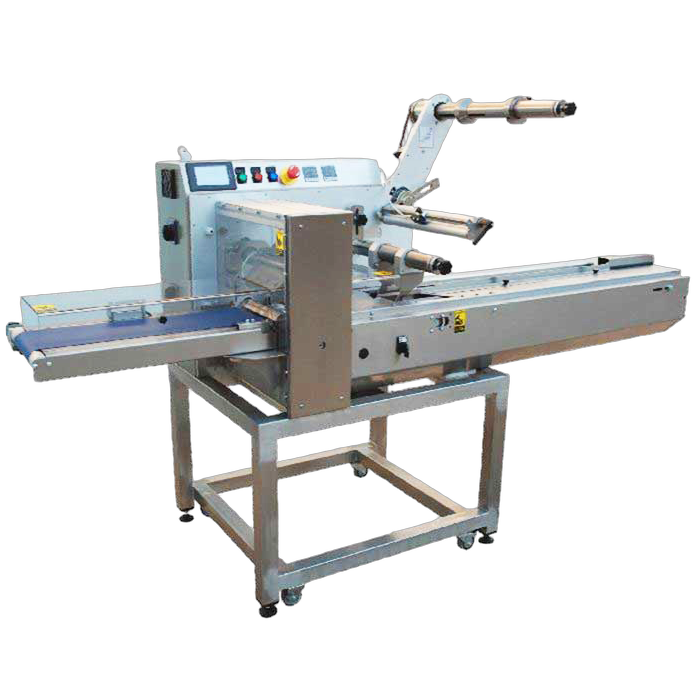
- Flow wrappers (horizontal FFS) wrap pre-formed solid products in a continuous film sheet: they are the correct specification for bars, biscuits, bakery, fresh produce trays, medical devices and any product with a consistent shape that feeds horizontally.
- VFFS machines (vertical form fill seal) form a bag from a flat film roll and fill it from above: they are the correct specification for granules, powders, liquids, snack foods, nuts, frozen items and any loose or free-flowing product that drops into a bag by gravity.
- If your product is a solid item with a defined shape → flow wrapper. If your product is loose, granulated, powdered or liquid → VFFS.
- Purchase price gap (2026 AUD): flow wrappers $15,000-$200,000+, VFFS machines $20,000-$250,000+. VFFS machines at the high end cost more due to integrated multihead weighers and gas flushing systems.
- Pack presentation differs: flow wrappers produce pillow packs with a fin or lap seal visible on the underside. VFFS machines produce pillow bags, gusseted bags or stand-up pouches with a vertical back seal.
- Both machine types are available from verified Australian suppliers on IndustrySearch.
Introduction
Flow wrappers and VFFS machines are the two most common primary packaging systems on Australian production lines - but they solve fundamentally different packaging problems. A flow wrapper feeds a solid product horizontally into a continuous film curtain, wrapping and sealing it in a pillow pack or fin-seal format. A VFFS machine forms a bag vertically from a flat film roll and fills it from above with a loose, granulated, powdered or liquid product. Choosing the wrong one creates a packaging mismatch that cannot be fixed with settings or accessories - the machine architecture does not suit the product format.
This comparison puts both systems side by side on capability, cost and the product characteristics that determine which one fits. To compare pricing, get quotes for flow wrappers and VFFS machines on IndustrySearch.
Operations where this comparison matters most:
- Food manufacturers launching a new product line and specifying the primary packaging system
- Contract packers evaluating which machine type covers the broadest range of client products
- Operations transitioning from manual packing to automated primary packaging
- Production engineers evaluating whether an existing flow wrapper or VFFS can handle a new product format
Match the machine to your product type
Before comparing costs, confirm what your product physically is. The product's form factor - solid vs loose, shaped vs free-flowing - determines the machine type. Price and features follow from there.
Factor | Flow Wrapper | VFFS Machine |
|---|---|---|
Product orientation |
Product feeds horizontally on a conveyor into a film curtain |
Product drops vertically by gravity into a formed bag |
Product type |
Solid, pre-formed items with a consistent shape |
Loose, granulated, powdered, liquid or free-flowing products |
Typical products |
Biscuits, bars, bakery, cheese portions, fresh produce trays, soap, medical devices |
Chips, nuts, coffee, flour, rice, frozen vegetables, pet food, liquids, powders |
Pack format |
Pillow pack with fin seal or lap seal on underside, three-side sealed |
Pillow bag, gusseted bag, stand-up pouch, quad-seal bag with vertical back seal |
Filling method |
Product placed on conveyor (manual or automatic infeed) |
Multihead weigher, volumetric filler, auger filler or liquid pump |
Shelf presentation |
Product visible through clear film or printed wrap - flat lay on shelf |
Bag stands upright (stand-up pouch) or hangs from clip strip - stronger brand panel area |
If your product is a solid item with a consistent cross-section that can travel on a conveyor without deforming → flow wrapper. If your product is loose, granulated, powdered, liquid or irregularly shaped and needs to be dropped or metered into a bag → VFFS. Some operations run both: a VFFS for the primary fill (e.g. snack food into bags) and a flow wrapper for the secondary pack (e.g. multipacks of bagged snacks).
Evaluate the key specifications
With your machine type confirmed, these are the specifications that determine whether a given model fits your product and line.
Specification | Flow Wrapper | VFFS Machine |
|---|---|---|
Speed range |
20-300+ packs/min |
30-120 bags/min (intermittent), 60-200+ bags/min (continuous) |
Bag/pack size range |
Width 50-350 mm, length virtually unlimited (cut to length) |
Width 60-400 mm, length 80-600 mm (set by former tube size) |
Film usage efficiency |
High - film wraps tightly around product with minimal excess |
Moderate - bag is formed to a fixed size regardless of fill level |
MAP capability |
Available with gas flush and hermetic seal (adds $10,000-$30,000) |
Available with gas flush (adds $8,000-$25,000) |
Weighing integration |
Checkweigher downstream (product already portioned) |
Multihead weigher or auger filler integrated above the forming tube |
Footprint |
Horizontal - long conveyor line, narrow width |
Vertical - taller machine, smaller floor footprint |
Changeover |
5-45 minutes depending on drive type |
15-60 minutes (former tube change and weigher recalibration) |
Understand the full cost comparison (2026 prices)
Purchase price is only part of the picture. Here is how the two machine types compare across the full cost of ownership.
Cost Category | Flow Wrapper (AUD) | VFFS Machine (AUD) |
|---|---|---|
Entry-level new |
$15,000-$35,000 |
$20,000-$50,000 |
Mid-range new |
$40,000-$80,000 |
$50,000-$120,000 |
High-speed new (with weigher/MAP) |
$80,000-$200,000+ |
$120,000-$250,000+ |
Used |
$10,000-$50,000 |
$15,000-$80,000 |
Film cost per unit |
$0.01-$0.05 |
$0.01-$0.06 (stand-up pouch film costs more than pillow bag) |
Annual maintenance |
$3,000-$10,000 |
$4,000-$12,000 (includes weigher calibration and former tube wear) |
Annual energy |
$1,500-$4,000 |
$2,000-$5,000 |
The most common mistake is trying to use a flow wrapper for a loose product or a VFFS for a solid pre-formed item. A flow wrapper cannot fill a bag with granules - the product must sit on a conveyor. A VFFS cannot wrap a solid bar without a tray or carrier, adding cost and complexity that a flow wrapper handles natively. The machine choice is driven by product form factor, not by price. Get quotes for flow wrappers and VFFS machines to compare delivered pricing for your specific product and volume.
Decision framework - flow wrapper vs VFFS
Decision Factor | Flow Wrapper Scores Higher When... | VFFS Scores Higher When... |
|---|---|---|
Product form |
Solid, pre-formed items with a consistent shape |
Loose, granulated, powdered, liquid or free-flowing |
Pack presentation |
Product visibility through clear film, flat retail shelf lay |
Stand-up pouch or gusseted bag with strong brand panel, vertical shelf presence |
Speed priority |
High-speed wrapping of uniform items (200-300+ ppm achievable) |
Moderate to high speed with integrated weighing (60-200 bpm typical) |
Weighing requirement |
Product is pre-portioned before wrapping (checkweigher downstream) |
Product needs to be weighed and dosed into the bag (multihead weigher integrated) |
Film efficiency |
Film wraps tightly around product - minimal excess material |
Bag formed to fixed size - some excess film if product does not fill bag fully |
Floor space |
Sufficient horizontal line length available |
Floor space is constrained - VFFS uses vertical height instead of horizontal length |
SKU variety |
Multiple solid products of similar shape - fast changeover on servo wrappers |
Multiple loose products of varying weight - weigher recalibration handles the range |
Secondary packaging |
Flow-wrapped items feed directly into case packers or display cartons |
Bags can be case-packed or display-ready depending on pouch format |
Evaluate suppliers
You are ready to go to market. Use this checklist to assess each supplier against the same criteria.
Factor | What to Ask |
|---|---|
Product trial |
Can you send product samples for a trial run on both machine types before committing? |
Application assessment |
Will the supplier review your product type, volume and pack format before recommending a machine? |
Delivered price |
Total delivered price including weigher (VFFS), infeed/outfeed, installation and commissioning? |
Film compatibility |
What film types does each machine handle? Can they run recyclable or paper-based alternatives? |
Warranty |
Warranty period for servos, seal system, weigher heads (VFFS) and controls? |
Parts and service |
Australian-stocked parts? Breakdown response time in your state? |
Line integration |
Can the machine integrate with your existing checkweigher, metal detector and case packer? |
Changeover time |
What is the changeover time for each machine type between your typical SKUs? |
Per-unit cost model |
Can the supplier model per-unit packaging cost (machine + film + labour) at your volume? |
Finance |
Chattel mortgage, operating lease or rent-to-own available? |
Frequently asked questions
When should i choose a flow wrapper over a VFFS?
Choose a flow wrapper when your product is a solid, pre-formed item with a consistent shape that can travel on a conveyor - biscuits, bars, cheese portions, medical devices. Flow wrappers produce tighter, more film-efficient wraps for solid items than a VFFS can achieve.
Can a VFFS wrap solid products?
A VFFS can bag solid items if they can drop freely through a forming tube by gravity. However, this limits product size and shape, requires a tray or carrier for fragile items, and produces a less precise wrap than a flow wrapper. For solid items, a flow wrapper is almost always the better specification.
What is the cost difference between a flow wrapper and VFFS?
At mid-range, flow wrappers cost $40,000-$80,000 vs $50,000-$120,000 for VFFS machines. VFFS costs more at the high end because the integrated multihead weigher adds $30,000-$80,000 to the system price. Running costs are broadly similar at equivalent volumes.
Can one production line use both machine types?
Yes. Some operations use a VFFS to fill primary bags (e.g. snack chips) and a flow wrapper downstream to create retail multipacks of those bags. This is common in snack food, confectionery and portion-controlled product lines.
Which machine has better shelf presentation?
Flow wrappers produce a tight, clear wrap that showcases the product shape - ideal for bakery and fresh food where visibility drives purchase. VFFS machines produce stand-up pouches and gusseted bags with a larger printable brand panel - ideal for snack foods and premium retail presentation where the bag design is the brand asset.
What matters most
- The decision is driven by product form factor - solid items need a flow wrapper, loose products need a VFFS
- VFFS machines cost more at the high end due to integrated weighing systems
- Flow wrappers deliver tighter, more film-efficient wraps for solid products
- VFFS machines offer stronger retail shelf presentation with stand-up pouch and gusseted bag formats
- Some lines use both: VFFS for primary fill, flow wrapper for secondary multipack
- Both machine types require FSANZ food-contact compliance and AS/NZS 4024 machine guarding for food applications
Most buyers shortlist 2-3 machines after running a product trial - if you are within 90 days of purchasing, start the comparison now.
Don't waste time contacting suppliers individually. IndustrySearch gives you direct access to verified Australian packaging machinery suppliers - where industrial buyers request and compare multiple quotes so they can buy with confidence.
- Get quotes for flow wrappers - contact multiple verified suppliers with a single enquiry
- Compare models - filter by machine type, speed and region
- Contact suppliers directly - speak to packaging specialists who service your state
→ Get and compare packaging machinery quotes now → industrysearch.com.au/buy/flow-wrapper
-160x160-state_article-rel-cat.png)