
Key takeaways
- Price range: Ride on sweepers cost $10,000-$80,000+; ride on floor scrubbers cost $8,000-$60,000+ in Australia (2026 new pricing).
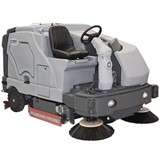
- Core difference: Sweepers collect dry debris (dust, grit, packaging) with rotating brushes and a vacuum system. Scrubbers wash, scrub and dry floors in a single pass using water, detergent and a squeegee system.
- If your floor problem is loose debris, dust or grit on dry surfaces: specify a sweeper. If your floor problem is stains, grease, spills or hygiene compliance on smooth surfaces: specify a scrubber.
- Combination machines: Sweeper-scrubber combos ($25,000-$90,000+) handle both tasks in one pass but carry higher purchase and maintenance costs. They are justified when both debris and wet cleaning are daily requirements on the same floor.
- Running costs are comparable: Both types cost $2,500-$8,000/year. Scrubbers add water and detergent ($500-$2,000/year); sweepers add more frequent brush replacement.
- Compliance driver: Food production, pharmaceutical and healthcare facilities typically require scrubbers for FSANZ or GMP hygiene compliance. Warehouses and logistics centres typically require sweepers for WHS dust control.
Ride on sweeper vs ride on floor scrubber Australia (2026): Which floor cleaning machine fits your facility?
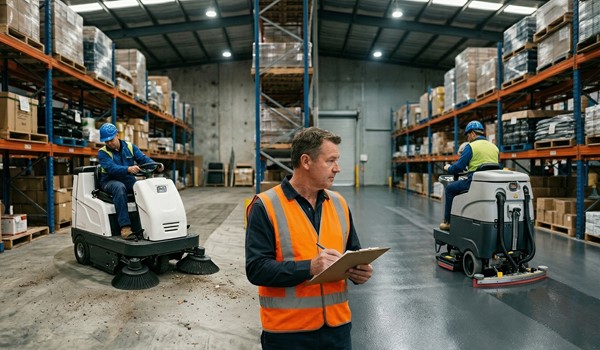
Ride on sweepers and ride on floor scrubbers are the two primary powered floor cleaning machines used in Australian warehouses, factories, retail centres and logistics facilities. Both are ride-on, battery or diesel powered, and cover large floor areas far faster than manual cleaning. But they solve different floor problems - and buying the wrong type means either pushing debris around a wet floor or scrubbing a dusty surface that needed sweeping first.
This guide compares both machine types across function, cost and facility fit. To compare pricing, get quotes for ride on sweepers or get quotes for ride on floor scrubbers on IndustrySearch.
Facilities where this decision drives the floor care equipment purchase:
- Warehouses and distribution centres with concrete floors accumulating dust and packaging debris
- Manufacturing plants requiring either dry debris removal or wet hygiene cleaning (or both)
- Shopping centres and car parks needing either litter/grit collection or wet floor cleaning
- Food production facilities requiring scrubbed floors for FSANZ hygiene compliance
Choose your floor cleaning requirement
Before costing anything, confirm whether your dominant floor problem is dry debris or wet contamination. Your answer determines the machine type.
Factor | Ride On Sweeper | Ride On Floor Scrubber |
|---|---|---|
Primary function | Collects dry debris: dust, grit, packaging, leaves | Washes and dries floors: removes grease, stains, spills |
Cleaning method | Rotating brushes + vacuum + hopper | Water + detergent + scrub pads + squeegee vacuum |
Floor condition after | Dry, debris-free | Clean, dry, sanitised |
Best floor type | Concrete, asphalt, paved - rough or smooth | Smooth concrete, epoxy, tile, sealed surfaces |
Outdoor capable | Yes - car parks, yards, loading docks | Limited - primarily indoor or undercover |
Price range (new) | $10,000-$80,000+ | $8,000-$60,000+ |
If your floor accumulates loose dust, grit or dry waste, specify a sweeper. If your floor needs scrubbing for grease, spills or hygiene compliance, specify a scrubber. If both problems exist on the same floor, consider a combination sweeper-scrubber or running both machines in sequence.
Sweepers are the default for warehouses, logistics centres, car parks and construction yards where the floor problem is dry particulate matter. They handle rough surfaces and outdoor areas that scrubbers cannot.
Scrubbers are the default for food production, pharmaceutical, healthcare and retail environments where floor hygiene and slip-resistance must meet regulatory standards. They require smooth, sealed surfaces to operate effectively.
Evaluate the key specifications
With your machine type confirmed, these are the specs that separate models within each category.
Specification | Typical Range | Buyer Consideration |
|---|---|---|
Cleaning width | 900-1,800 mm (both) | Match to aisle width and daily coverage target. Wider = fewer passes |
Hopper/tank capacity | Sweeper: 50-200 L / Scrubber: 60-300 L | Larger capacity = longer runtime between dump/refill cycles |
Battery runtime | 2-6 hours (both) | Must cover a full shift. Lithium batteries recharge faster for multi-shift use |
Filtration | Sweeper: panel or HEPA | HEPA filtration is mandatory for food, pharma and fine-dust environments |
Water usage (scrubber) | 1-5 L per minute | Lower usage = fewer refills but may reduce cleaning intensity on heavy soiling |
The most common mistake is using a scrubber on a floor with heavy dry debris. Scrubbers are not designed to pick up gravel, bolts or packaging - the debris blocks squeegees, damages pads and creates streaking. Always sweep first, then scrub if both tasks are needed.
Understand the full cost breakdown (2026 prices)
Purchase prices are comparable. The running cost difference is in consumable type, not total amount.
Category | Ride On Sweeper (AUD) | Ride On Floor Scrubber (AUD) |
|---|---|---|
Entry-level new | $10,000-$25,000 | $8,000-$20,000 |
Mid-range new | $25,000-$50,000 | $20,000-$40,000 |
Heavy-duty new | $50,000-$80,000+ | $40,000-$60,000+ |
Annual consumables | $1,000-$2,500 (brushes, filters) | $1,500-$3,500 (pads, squeegees, detergent) |
Annual energy (battery) | $1,500-$3,000 | $1,500-$3,000 |
Over 5 years at comparable utilisation, both machine types cost roughly the same to own and run. The decision is driven by floor cleaning requirement, not price. If you are within 4 weeks of purchasing, get quotes for ride on sweepers to compare current supplier pricing.
Decision framework - sweeper vs scrubber
Decision Factor | Choose Ride On Sweeper | Choose Ride On Floor Scrubber |
|---|---|---|
Floor contamination | Dry debris: dust, grit, packaging, leaves | Wet/oily: grease, spills, scuff marks, stains |
Floor surface | Rough concrete, asphalt, paved | Smooth concrete, epoxy, tile, sealed |
Indoor/outdoor | Both - works outdoors on rough surfaces | Indoor or undercover only |
Compliance driver | WHS dust control, silica dust management | FSANZ food safety, GMP hygiene, slip-resistance |
Finish required | Debris-free, dry | Clean, sanitised, dry, streak-free |
Both tasks needed | Sweep first, then scrub - or use a combination machine | Sweep first, then scrub - or use a combination machine |
Evaluate suppliers
You are ready to go to market. Use this checklist to compare both machine types.
Factor | What to Ask |
|---|---|
Both types available | Can the supplier quote both sweeper and scrubber models for comparison? |
Demo on your floor | Can you trial the machine on your actual floor surface before committing? |
Consumable pricing | What is the annual consumable cost for brushes/pads, filters/squeegees and detergent? |
Battery warranty | What is the battery warranty and expected replacement cost? |
Service network | Where is the nearest service centre? Is mobile service available? |
Combination option | Does the supplier offer a sweeper-scrubber combination unit? At what price premium? |
Training | Does the supplier provide operator training at delivery? |
Frequently asked questions
Can a ride on floor scrubber replace a ride on sweeper?
Not for heavy dry debris. Scrubbers cannot effectively pick up gravel, bolts or large packaging - the debris damages pads and blocks squeegees. Always sweep first if dry debris is present.
When should i buy a combination sweeper-scrubber instead of separate machines?
When both dry debris and wet soiling are daily problems on the same floor and you want to clean in a single pass. Combination units cost $25,000-$90,000+ and are justified when running two separate machines is impractical.
Which type has lower running costs over 5 years?
Running costs are comparable at $2,500-$8,000/year for both types. Scrubbers add water and detergent cost; sweepers add more frequent brush replacement. The difference is negligible over 5 years.
Do food production facilities need a scrubber or a sweeper?
Scrubbers are the default for food production floors under FSANZ hygiene requirements. A sweeper may also be needed for dry debris removal before scrubbing, depending on the production environment.
Which machine works on rough outdoor concrete?
Sweepers handle rough concrete, asphalt and outdoor surfaces. Scrubbers require smooth, sealed surfaces - they are not effective on rough or uneven outdoor concrete.
What matters most
- Floor contamination type determines the machine: dry debris = sweeper; wet/grease = scrubber
- Surface matters: rough/outdoor = sweeper; smooth/sealed = scrubber
- Compliance drives the choice in regulated environments: WHS dust = sweeper; FSANZ/GMP hygiene = scrubber
- Running costs are comparable: choose on function, not price
- Combination units exist: justified when both debris and wet cleaning are daily requirements on the same floor
Most buyers shortlist 2-3 models after getting quotes across both types.
Don't waste time contacting suppliers individually. IndustrySearch gives you direct access to verified Australian floor cleaning equipment suppliers - where industrial buyers request and compare multiple quotes so they can buy with confidence.
- Get quotes for ride on sweepers - contact multiple verified suppliers with a single enquiry
- Compare models - filter by capacity, configuration and region
- Contact suppliers directly - speak to specialists who service your state
? Get and compare ride on sweeper quotes now ?


-160x160-state_article-rel-cat.png)