Conventional barcodes just get wider as more data is encoded, while 2D barcodes can also make use of the vertical dimension to pack more data in.
Barcodes have become widely popular because of their reading speed, accuracy, and superior functionality characteristics.
As barcodes became popular and their convenience universally recognised, the market began to call for codes capable of storing more information, more character types, and that could be printed in a smaller space.
As a result, various efforts were made to increase the amount of information stored by bar codes, such as increasing the number of barcode digits or laying out multiple bar codes.
However, these improvements also caused problems such as enlarging the barcode area, complicating reading operations, and increasing printing cost.
2D barcodes have emerged in response to these needs and problems.
As shown in the diagram above, a 2D barcode contains information in both the vertical and horizontal directions, whereas a conventional barcode contains data in one direction only.
A typical 2D barcode can hold considerably more information than a conventional barcode - most barcodes can comfortably store a maximum of around 20 digits, while QR Code, for example, is able to hold much more information - up to 7,089 digits, or up to 4,296 alphanumeric characters.
Two of the most popular types of 2D barcodes, QR Code and GS1 Databar (RSS).
Which ASP Scanners read 2D Barcodes?
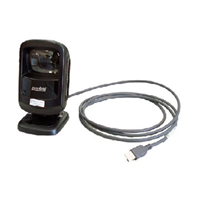
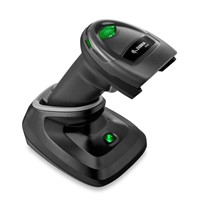
Listed below are some of the units that are able to scan 2D barcodes:
- SlimScan 2D
- Denso BHT-700
- Denso BHT-300Q
- Denso AT-10Q
- Denso GT-10
- Casio DT-X7
- Casio DT-X30
- Casio IT-3100
- Casio IT-800
- Casio DT-X8
For more information on these products please call or use the enquiry box for a direct reply