

-720x400.jpg)
-720x400.jpg)

-720x400.jpg)

For recycling businesses in Australia and New Zealand, a reliable metal baler is essential for keeping scrap moving efficiently. One New Zealand recycler recently replaced an aging baler after repeated problems with scrap steel racks, aluminium cans, mixed metal scrap and industrial offcuts.
The customer originally found ENERPAT through Google while searching for “Non Ferrous Baler for Sale.”
When an Old Baler Becomes a Production Bottleneck
The customer's existing hydraulic baler was still operating, but frequent problems were making daily production increasingly difficult.
Aluminium cans and smaller pieces of scrap could become trapped between the main cylinder and side cylinder. The resulting metal-to-metal contact caused excessive noise and forced operators to stop and manually clear the material.
The customer estimated that these interruptions could take around 1–2 hours per shift, depending on operating conditions.
The side cylinder also occasionally stalled during its return stroke. A previous forklift impact had affected the machine frame and travel-switch alignment, resulting in unreliable signal feedback.
At the same time, the hydraulic system could not consistently maintain normal working pressure. Operators had to manually reduce the pressure to keep the machine running, resulting in lower bale density and inconsistent production.
As the customer's maintenance manager put it:
“We were spending too much time clearing jams instead of running the baler.”
The Customer Saw the Machine Running in Australia
Before making the investment, the customer wanted to see how the machine performed in a real recycling environment.
Instead of relying only on specifications and videos, ENERPAT arranged a visit to an existing customer site in Australia.
The customer was able to see the baler operating firsthand, watch the cylinder movements, observe the compression process and inspect the finished bales.
Seeing the machine running under real working conditions gave the customer much greater confidence in its reliability and bale quality.
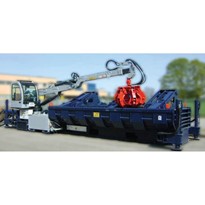
Following the visit, the customer selected the ENERPAT AMB-L2520-250 250-ton door-lid metal baler.
AMB-L2520-250: Built for Heavy-Duty Scrap
The AMB-L2520-250 features:
- Compression force: 250 tons
- Chamber size: 2500 × 2000 × 1200 mm
- Bale size: 500 × 500 mm
- Motor power: 30 kW × 2
- Configuration: Hydraulic door-lid metal baler
The large chamber is particularly suitable for bulky materials such as scrap steel racks, while the door-lid structure provides strong containment during compression and helps produce dense, consistent bales.
The Result: More Stable Production
After installation and commissioning, the customer reported smoother cylinder movement, more stable hydraulic pressure and significantly fewer material-jamming problems.
Operating noise was also reduced, and the machine was able to produce more consistent, dense bales.
Based on the customer's previous downtime and expected operating conditions, ENERPAT estimates an approximately 30% improvement in effective productivity compared with the old baler.
This is an estimated improvement, not a guaranteed or independently measured result. Actual performance depends on material type, loading method, operator efficiency and working conditions.
The biggest improvement was simple: less time spent stopping the machine and more time spent processing scrap.
A Practical Reference for Australian Recyclers
This New Zealand installation is highly relevant to Australian recyclers handling scrap steel, steel racks, aluminium cans and mixed metal scrap.
For Australian projects, machine guarding, electrical configuration and installation should be reviewed against the applicable local requirements. AS/NZS 4024.1 may be relevant to the machinery safety assessment, depending on the specific machine configuration and installation.
ENERPAT also provides local support in Australia, including technical assistance and spare-parts support, with an Australian operation based in Sydney.
If you are replacing an aging scrap metal baler or non-ferrous baler, ENERPAT can assess your material, bale size and production requirements and recommend a suitable configuration.



-160x160-state_article-rel-cat.png)


-160x160-state_article-rel-cat.png)


-205x205.jpg)
-205x205.jpg)

-205x205.jpg)
-205x205.jpg)
-205x205.jpg)
-205x205.jpg)
-205x205.jpg)