
CNC Lathe & Turning Machine

Join industrial buyers comparing supplier quotes and buying with confidence. Free, quick and easy.


How IndustrySearch works
Tell us what you need
Answer a few quick questions about the equipment you're looking for.
Get personalised quotes
Receive tailored quotes from relevant Australian suppliers.
Compare and choose
Compare quotes, ask questions and choose the best option for you.
 Save time
 Compare quotes
 Buy with confidence
Save time, compare quotes & buy with confidence
CNC Lathe & Turning Machine Suppliers
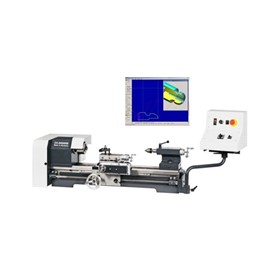
A computer numerical controlled (CNC) lathe is a machine that rotates a workpiece against a stationary cutter to remove material in a circular path. CNC Lathes are ideal for machining parts that are symmetrical and require a high quality finish. The lathe is controlled by design instructions inputted by an operator through the machine’s software. This allows a computer model to be transformed into a physical part.
CNC lathes have numerous benefits when compared to traditional manual machines. First, they remove human error during the machining process, resulting in less wasted material. CNC lathes also improve manufacturing times as one operator is able to monitor multiple machines at once.
The high precision cutting technology produces repeatable results and the machines are able to operate for extended periods of time without pause making them ideal for mass production. CNC lathe machines are used to produce a variety of products across a range of industries such as pipes, bolts, shafts, tools, pistons, automotive frames, surgical instruments and gears.

We offer high precision conventional and CNC lathes, conventional and CNC milling machines, and accessories such as vices, dividing heads, measuring tools, digital displays, drill chucks, collet holders, turning tools, knurling tools, thread cutting attachments, clamping tools, machine stands and lights. For model construction, horology, precision mechanical devices, building of ...
CNC Lathe & Turning Machine Buying Guide
Looking for a CNC Lathe for sale in Australia? Browse cnc machines from verified suppliers on IndustrySearch, Australia's industrial equipment marketplace. Contact vendors for a free quote or to get expert advice on cnc lathes.

- The installation process involves several steps, including positioning the machine, connecting power and air supplies, and verifying the electrical and mechanical connections. The supplier or manufacturer usually provides an installation manual or technician to oversee the installation process.
- The installation process may take several days or weeks, depending on the complexity of the machine and the site conditions. After installation, the machine needs to be calibrated and tested to ensure it is operating correctly.
- Basic machine knowledge: The operator should have a basic understanding of the machine's components, including the spindle, chuck, tailstock, and tool turret.
- Programming: The operator should learn how to program the machine using software such as G-code or CAM software. This includes creating tool paths, selecting cutting tools, and setting cutting parameters.
- Tooling: The operator should understand how to select and install cutting tools, including tool holders and inserts.
- Setup: The operator should learn how to set up the workpiece in the machine, including securing it in the chuck or collet, and aligning it with the spindle axis.
- Operation: The operator should learn how to operate the machine, including starting and stopping the spindle, adjusting cutting parameters, and monitoring the machining process.
- Maintenance: The operator should understand how to perform routine maintenance tasks, such as cleaning, lubricating, and replacing worn parts.
- Safety: The operator should be trained on safety procedures, including wearing appropriate PPE, avoiding hazards such as pinch points, and handling hazardous materials such as coolant.
CNC Lathe & Turning Machine Costs and Supplier Insights
Buy a CNC Lathe & Turning Machine Near Me
CNC Lathe & Turning Machine Articles & Reviews


 Reach valuable industrial buyers in minutes
 Promote key products & content
 Drive cost effective & measurable sales