
Power Quality Analyser

Join industrial buyers comparing supplier quotes and buying with confidence. Free, quick and easy.







How IndustrySearch works
Tell us what you need
Answer a few quick questions about the equipment you're looking for.
Get personalised quotes
Receive tailored quotes from relevant Australian suppliers.
Compare and choose
Compare quotes, ask questions and choose the best option for you.
 Save time
 Compare quotes
 Buy with confidence
Save time, compare quotes & buy with confidence
Power Quality Analyser | Recorder & Logger Suppliers
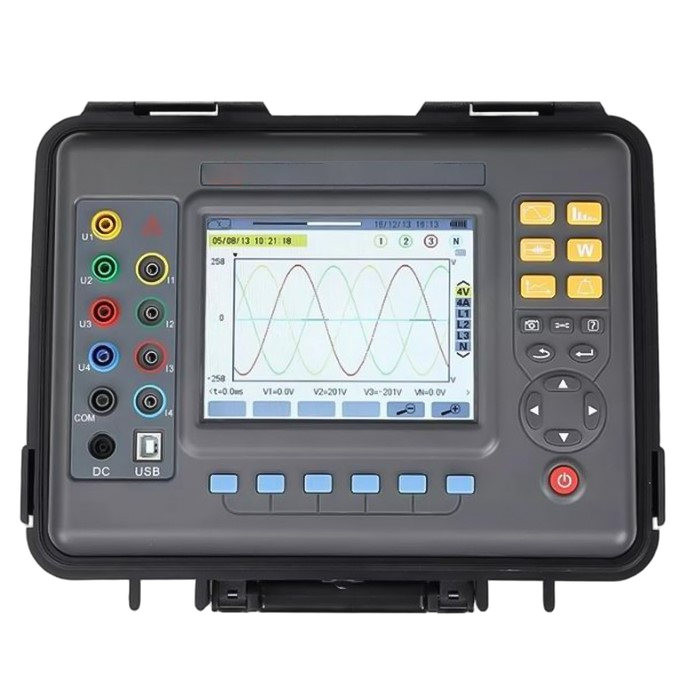
Power quality analysers analyse the quality of power in both single and three phase installations. They assess all parameters that may affect that installation’s power and provide detailed information as to whether everything’s working as it should.
To the uninitiated, a power quality analyser might seem a rather foreign and highly technical device. But to those charged with the responsibility of optimising power to essential machines in an office, factory or warehouse, they can be a real lifesaver.
Why? Because power quality analysers are designed to spot potential faults and power load issues before they cause untold problems through equipment malfunction and downtime. They can also tell when equipment is operating inefficiently and wasting power unnecessarily.
And while the intricacies and myriad available features of power supply monitors can be overwhelming, there are ways to narrow down your options and find the right unit for your needs.
A power quality analyser is an investment in electrical supply reliability, equipment efficiency and overall business productivity. Whether it’s single or three-phase, predictive maintenance, service quality compliance or general load studies, there’s a power quality analyser to suit.

With more than 150 branches across Australia and New Zealand, Kennards Hire is Australia’s #1 family-owned supplier of high quality, equipment for hire.


Our customers count on us for rugged, reliable and accurate test instruments. We offer test, measurement and monitoring products and software that are used in electronic design, manufacturing, and network troubleshooting, as well as in electrical, industrial, medical, process and calibration applications.

Fluke 1736 and 1738 Three-Phase Power Quality Loggers
Fluke 1742, 1746 and 1748 Three-Phase Power Quality Loggers

From a small family loan of $10,000 in 1957 to a global company with more than 8,700 employees in over 50 countries, Anixter has been redefining the distribution of wire and cable for nearly 60 years. When Anixter wrote The Blue Book in 1968, the company reached more than $10 million in sales and had 700 employees. By 1980, Anixter had more than 2,000 employees and added ...


Queensland Calibrations is a privately owned, Brisbane based company providing sales, calibration services and repairs for a comprehensive range of test and measurement equipment. In this location, we maintain an organised and responsive local warehouse, and specialised calibration facilities where all repairs, tests and calibrations are performed in a purpose built and controlled ...


- What are the benefits of using a Power Quality Analyser?
- What are the different types of Power Quality Analysers available in Australia?
- How do I choose the right Power Quality Analyser for my needs?
- What are the key features to look for in a Power Quality Analyser?
- How accurate are Power Quality Analysers?
- How do I install and use a Power Quality Analyser?
- What is the cost of a Power Quality Analyser in Australia?
- Are there any maintenance requirements for a Power Quality Analyser?
- Sampling rate: The sampling rate determines how often the analyser takes measurements. A higher sampling rate provides more detailed information about the power quality.
- Data storage: The power quality analyser should have sufficient data storage capacity to store all the measurements taken over a period of time.
- Display: The display should be easy to read and provide clear information about the power quality parameters being measured.
- Connectivity: The power quality analyser should have connectivity options such as USB, Ethernet, or Wi-Fi to transfer data to a computer or other devices.
- Software: The software provided with the power quality analyser should be user-friendly and provide detailed analysis of the data collected.
- Battery life: The battery life of the power quality analyser is important, especially if it needs to be used for extended periods of time.
- Look for anomalies: Check for any anomalies in the data such as voltage sags, swells, or interruptions. These can indicate problems in the electrical system.
- Analyze harmonics: Harmonics are a common cause of power quality issues. Analyze the harmonic data to identify any issues and their severity.
- Compare with standards: Compare the measured data with industry standards such as IEEE 519 or EN 50160 to determine if the electrical system is within acceptable limits.
- Identify root cause: Once you have identified any issues, try to identify the root cause. This may require further investigation or testing.
Power Quality Analyser Costs and Supplier Insights
Buy a Power Quality Analyser Near Me
Power Quality Analyser Articles & Reviews



 Reach valuable industrial buyers in minutes
 Promote key products & content
 Drive cost effective & measurable sales