
Oscilloscope

Join industrial buyers comparing supplier quotes and buying with confidence. Free, quick and easy.
How IndustrySearch works
Tell us what you need
Answer a few quick questions about the equipment you're looking for.
Get personalised quotes
Receive tailored quotes from relevant Australian suppliers.
Compare and choose
Compare quotes, ask questions and choose the best option for you.
 Save time
 Compare quotes
 Buy with confidence
Save time, compare quotes & buy with confidence
Oscilloscope Suppliers

The Emona Group of companies was established in 1979 by Mr Alfred (Fred) Brežnik AM. From our start as a single person office importing and distributing electronic test instruments, the Emona Group has diversified and grown to cover imports, manufacturing and exports, with sales offices around Australia. Emona Instruments also has a representative office outside of Denver, CO, ...


Oscilloscope Buying Guide
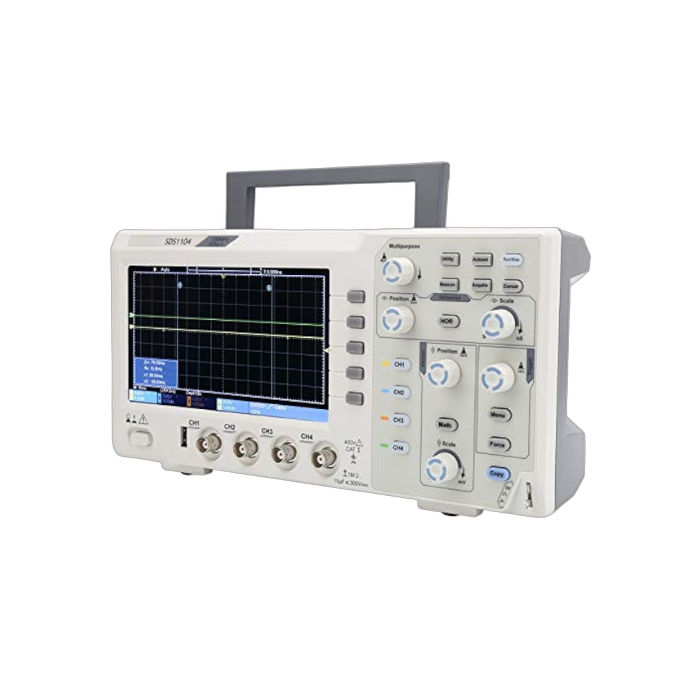
Find and buy oscilloscopes and spectrum analysers from verified suppliers on IndustrySearch. Oscilloscopes and spectrum analysers are electronic test instruments for observing signals as a function of time and as a function of frequency respectively.
Things to consider when buying oscilloscopes and spectrum analysers:
- Know your application - Important factors to know before getting started are portability needs, number of signal inputs, desired sample rate per second, signal amplitude and frequency range, and whether you solely need an oscilloscope, a spectrum analyzer or a machine that combines both functions
- Calculate your instrument’s required memory - Depending on your required sample rate per second, calculate the total amount of storage memory you need to log data for your required logging time.
- Choose your oscilloscope’s number of channels - Oscilloscopes with 2 or 4 channels are available, which offer the user multiple signals comparison capabilities, in real-time.
- Know your bandwidth - Apart from simple signal waveforms, signals often include higher frequency harmonics, requiring a higher bandwidth than initially expected. A rule of thumb is to select an instrument with a bandwidth five times higher than the maximum signal frequency you wish to measure.
- Choose for appropriate accuracy - Oscilloscopes and spectrum analysers come in a variety of frequency and level accuracy. Make sure you select an instrument with the appropriate accuracy levels for your application.
- Consider specialized application requirements - Specialized requirements include oscilloscopes with 12 or 16 bit resolution, small instrument form factor and increased portability requirements, spectrum analyzers with increased bandwidth resolution and low sweep speeds requirements.
Contact our vendors for a free quote or expert advice on oscilloscopes and spectrum analysers. Delivery available Australia wide.

- Bandwidth: The bandwidth determines the highest frequency that the oscilloscope can accurately measure. A higher bandwidth means that the oscilloscope can measure faster signals.
- Sample rate: The sample rate determines how many data points the oscilloscope can take in a given time. A higher sample rate means that the oscilloscope can capture more detail in the signal.
- Number of channels: The number of channels determines how many signals the oscilloscope can measure at once. A two-channel oscilloscope is the most common, but some applications may require more channels.
- Display: The display should be clear and easy to read, with adjustable brightness and contrast. Some oscilloscopes may also have a touch screen display for easier navigation.
- Triggering: Triggering allows the user to set a threshold for the oscilloscope to start measuring the signal. This is important for capturing specific events or signals.
- Probes: Probes are the devices that connect the oscilloscope to the circuit being measured. Quality probes are important for accurate measurements and signal integrity.
- Software: Some oscilloscopes come with software that allows for more advanced analysis and data logging. This can be useful for more complex applications.
- Analog oscilloscopes use a cathode-ray tube (CRT) to display the waveform on a screen. The input signal is amplified and then used to deflect the electron beam on the CRT. The resulting image can be used to measure various aspects of the waveform, such as amplitude, frequency, and phase.
- Digital oscilloscopes, on the other hand, use an analog-to-digital converter (ADC) to sample the input signal and then display it on a screen. The sample data is stored in memory and then processed by digital signal processing (DSP) algorithms to display the waveform. Digital oscilloscopes offer several advantages over analog oscilloscopes, such as the ability to capture and store waveforms, and the ability to perform more advanced signal analysis.
- Tektronix: Tektronix is a leading manufacturer of oscilloscopes, offering a wide range of models from basic to advanced. Their oscilloscopes are known for their accuracy, reliability, and ease of use.
- Keysight Technologies: Keysight Technologies is another well-known brand of oscilloscopes. They offer a range of scopes for different applications, including digital and mixed-signal oscilloscopes.
- Rigol Technologies: Rigol Technologies is a Chinese company that produces high-quality oscilloscopes at an affordable price. Their scopes are popular among hobbyists and professionals alike.
- Fluke Corporation: Fluke Corporation is a US-based company that produces a range of test and measurement equipment, including oscilloscopes. Their scopes are known for their accuracy and durability.
- GW Instek: GW Instek is a Taiwanese company that produces a range of test and measurement equipment, including oscilloscopes. Their scopes are popular among engineers and scientists for their accuracy and reliability.
Oscilloscope Costs and Supplier Insights
Buy a Oscilloscope Near Me

 Reach valuable industrial buyers in minutes
 Promote key products & content
 Drive cost effective & measurable sales