
Thermal Imaging Camera

Join industrial buyers comparing supplier quotes and buying with confidence. Free, quick and easy.


How IndustrySearch works
Tell us what you need
Answer a few quick questions about the equipment you're looking for.
Get personalised quotes
Receive tailored quotes from relevant Australian suppliers.
Compare and choose
Compare quotes, ask questions and choose the best option for you.
 Save time
 Compare quotes
 Buy with confidence
Save time, compare quotes & buy with confidence
Thermal Imaging Camera & Infrared Camera Suppliers
Originally developed for military operations and surveillance, thermal imaging cameras are now used for many industrial and medical applications. These include; firefighting, autonomous vehicles and building inspections.
A thermal camera is a non-contact device that detects infrared energy (thermal energy or heat) and converts it into a visual image. Everything gives off thermal energy—even ice. The hotter something is the more thermal energy it emits. This energy is called a “heat signature.” When two objects next to one another have even subtly different heat signatures, they can be detected by thermal sensors regardless of lighting conditions.
The primary components of a thermal imaging camera are the lens, the thermal sensor and processing electronics. The lens focuses thermal energy onto the sensor. The sensors come in a variety of pixel configurations from 80 × 60 to 1280 × 1024 pixels or even higher. The resolution is low compared to regular digital cameras. This is because thermal detectors need to sense energy that has larger wavelengths than visible light so requires the sensor elements to be larger.

RS Components is your one stop distributor for electrical, industrial, automation & control gear, electronics, test & measurement, safety and more - with over 600,000 products from more than 2,500 leading global suppliers including RS PRO, Fluke, TE Connectivity, Phoenix Contact, Schneider, Siemens, ABB, Omron, Harting and more. With free delivery for orders over $125 excl. ...
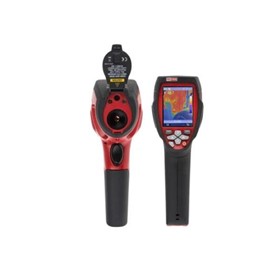

- Thermal imaging cameras work by detecting and measuring the infrared radiation emitted by objects. The camera has a sensor that detects the infrared radiation and converts it into an electrical signal. The signal is then processed by the camera's software, which creates an image that represents the temperature of the objects in the scene.
- The images produced by thermal imaging cameras are typically displayed in different colors to represent different temperatures. Cooler areas are typically shown in blue or green, while warmer areas are shown in yellow, orange or red. This makes it easy for users to distinguish between different temperature ranges and identify any anomalies or hotspots in the scene.
- Electrical inspections: Thermal cameras can detect hot spots in electrical systems, which can indicate potential faults and hazards.
- Building inspections: Thermal imaging can help identify energy loss, moisture damage, and structural issues in buildings.
- Industrial inspections: Thermal cameras can be used to detect leaks in pipelines, identify hot spots in machinery, and monitor production processes.
- Firefighting: Thermal imaging can help firefighters locate people and hot spots in burning buildings, and also identify potential sources of ignition.
- Law enforcement: Thermal cameras can be used for surveillance, search and rescue operations, and to detect hidden objects or individuals.
- Medical applications: Thermal cameras can detect changes in body temperature and blood flow, which can help diagnose medical conditions.
- Wildlife monitoring: Thermal cameras can be used to track and monitor animal populations, and to detect poachers.
- Environmental monitoring: Thermal imaging can help identify and track changes in vegetation and water resources.
- Consider the application: Different thermal imaging cameras are designed for different applications, so it's important to consider what you will be using the camera for. Some common applications include building inspections, electrical inspections, and mechanical inspections.
- Resolution: The resolution of a thermal imaging camera determines the level of detail in the images it produces. Higher resolution cameras will produce more detailed images but can be more expensive.
- Temperature range: Different cameras have different temperature ranges, so it's important to choose a camera that can measure the temperatures you need for your application.
- Features: Some cameras come with additional features such as image storage, video recording, and Wi-Fi connectivity. Consider which features are important to you.
- Brand and reliability: Choose a reputable brand and ensure the camera has a good track record for reliability and durability.
- After-sales support typically includes technical support, repair or replacement services, and software updates. Some manufacturers provide phone and email support, while others offer online resources such as user manuals, FAQs, and video tutorials. Some manufacturers may also offer training programs and certification courses for their products.
Thermal Imaging Camera Costs and Supplier Insights
Buy a Thermal Imaging Camera Near Me
Thermal Imaging Camera Articles & Reviews
-
![]() Buying guide
Safety And Compliance In Thermal Imaging Applications With Thermal Imaging Cameras in Thermal-imaging-camera
Read guide
-
![]() Buying guide
Advancements and Innovations in Thermal Imaging Technology of Thermal Imaging Cameras in Thermal-imaging-camera
Read guide
-
![]() Buying guide
Optimizing Thermal Inspections And Analysis With Thermal Imaging Cameras in Thermal-imaging-camera
Read guide
-
![]() Buying guide
Integration And Connectivity Of Thermal Imaging Cameras In Industrial Systems in Thermal-imaging-camera
Read guide
-
![]() Buying guide
Maintenance And Care Of Thermal Imaging Cameras in Thermal-imaging-camera
Read guide
-
![]() Buying guide
Choosing The Right Thermal Imaging Camera: A Comprehensive Buying Guide in Thermal-imaging-camera
Read guide



 Reach valuable industrial buyers in minutes
 Promote key products & content
 Drive cost effective & measurable sales