
TIG Welder

Join industrial buyers comparing supplier quotes and buying with confidence. Free, quick and easy.





How IndustrySearch works
Tell us what you need
Answer a few quick questions about the equipment you're looking for.
Get personalised quotes
Receive tailored quotes from relevant Australian suppliers.
Compare and choose
Compare quotes, ask questions and choose the best option for you.
 Save time
 Compare quotes
 Buy with confidence
Save time, compare quotes & buy with confidence
TIG Welder & AC/DC TIG Welder Suppliers
A tungsten inert gas (TIG) welding machine is used to create fixed rigid metal joints. The process involves temporarily melting two pieces of metal that are in close proximity together and fusing them upon cooling. Industry professionals use different welding techniques depending on the desired production specifications and materials involved in the project. However, TIG welding is known to produce the strongest and most precise welds compared to all other welding types.
TIG welding differs from metal inert gas (MIG) and stick welding as it does not require consumable filler materials such as wire and rod to be performed. Instead, TIG welding machines use a non-consumable welding electrode with an extremely high melting point, far greater than the workpiece, to generate sufficient heat resulting in molten metal. This technique of welding has the versatility to weld thicker workpieces and a greater range of metal types (including aluminium) that other types of welding are not.
TIG welding machines are made of strong, impact proof material making them suitable for most work environments. Features include a foot pedal or thumb wheel to control the amount of heat produced by the welding torch, a thermostat controlled fan to regulate machine temperature and a removable steel mesh dust filter.

We're an Australian company, 100% owned in Australia, run by Australian people. Weldclass products are developed for Australian welders and metal fabricators and are sold through our network of over 1,000 distributors across Australia and the south Pacific region. We offer market-leading products and reliable supply with a focus on simplicity, great presentation, and a ...
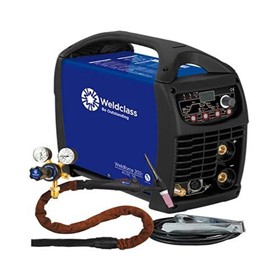


- Amperage range: The amperage range of the TIG welder is an important consideration. The amperage range determines the thickness of the metal that can be welded. A TIG welder with a wider amperage range will be more versatile.
- AC/DC functionality: TIG welders can be either AC or DC, or both. AC is used for welding aluminum, while DC is used for welding steel and other metals. A TIG welder with both AC and DC functionality will be more versatile.
- Duty cycle: The duty cycle is the amount of time the TIG welder can be used before it needs to cool down. A higher duty cycle means the TIG welder can be used for longer periods without overheating.
- Foot pedal: A foot pedal allows the welder to control the amperage while welding. This feature is important for precise control and can make a significant difference in the quality of the weld.
- Pulse and frequency control: Pulse and frequency control allows the welder to adjust the arc length and heat input, which is important for welding thin metals.
- Portability: Portability is important if you need to move the TIG welder from one location to another. Some TIG welders are more compact and lightweight than others.
- Price: The price of a TIG welder can vary greatly depending on the features and quality. It is important to set a budget and look for a TIG welder that meets your needs within that budget.
- Wear protective clothing and gear, such as a welding helmet, gloves, and a jacket made from flame-resistant materials.
- Ensure that the work area is well-ventilated to avoid inhaling toxic fumes.
- Keep a fire extinguisher nearby in case of any accidents or emergencies.
- Inspect the TIG welder and all its components, including cables and hoses, for any damage or wear.
- Ensure that the TIG welder is grounded properly to prevent electrical shock.
- Avoid touching the electrode or metal parts of the TIG welder with bare hands while it is in use.
- Always switch off the TIG welder and disconnect it from the power source when not in use.
- Do not weld on containers that previously held flammable liquids or gases.
- Keep a first aid kit nearby in case of any injuries.
TIG Welder Costs and Supplier Insights
Buy a TIG Welder Near Me

 Reach valuable industrial buyers in minutes
 Promote key products & content
 Drive cost effective & measurable sales