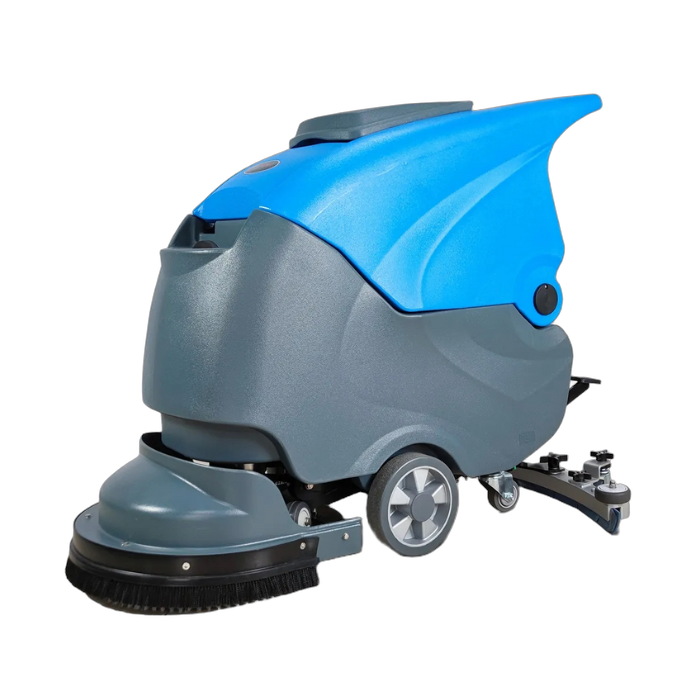

Key takeaways
- New price range: Walk behind floor scrubbers cost $2,000–$15,000 in Australia depending on scrub width, tank capacity and battery type (2026 pricing).
- Annual running costs: $1,200–$4,000 covering brushes/pads, squeegee blades, cleaning chemical and electricity.
- 3-year TCO: $4,500–$22,000 all-in. Purchase price accounts for 60–75% of the total; the remainder is consumables and battery replacement.
- Labour payback vs mop and bucket: A $7,000 mid-range unit saves $12,000–$20,000/year in cleaning labour on a daily-clean 2,000 m² facility. Payback is 5–8 months.
- If you clean 1,000+ m² daily with mop and bucket: You are spending $8,000–$15,000/year in avoidable labour. A walk behind scrubber eliminates 50–70% of that cost from month one.
- Rental option: Short-term rental runs $150–$350/month - viable for seasonal facilities or pre-purchase trials.
- Depreciation: ATO effective life 5–7 years. Most units qualify for the $20,000 instant asset write-off.
What walk behind floor scrubbers actually cost in Australia
Walk behind floor scrubbers are one of the few equipment categories where the purchase price is the smaller number. The real financial case sits in the labour hours they eliminate. A facility spending $15,000–$25,000/year on manual mopping labour can replace that cost with a $5,000–$10,000 machine that pays for itself within the first year - yet many operations never model the comparison because they frame the scrubber as a cost rather than a labour offset.
This guide breaks down every cost component so your approval document shows the full financial picture. Get quotes for walk behind floor scrubbers to compare current supplier pricing against these benchmarks.
Choose your price bracket by machine size
Machine size sets the price floor. Each size class carries a different purchase cost and a different labour saving profile.
Size Class | New Price (AUD) | Key Cost Driver |
|---|---|---|
Compact (350–450 mm) | $2,000–$5,000 | Lower consumable cost; limited area coverage per charge |
Mid-range (500–650 mm) | $5,000–$10,000 | Best ROI range - highest labour saving per dollar spent |
Large (700–850 mm) | $10,000–$15,000 | Justified only above 3,000 m² daily; compare against ride-on TCO at this level |
The mid-range bracket delivers the strongest ROI for most Australian operations. Below $5,000, area coverage limitations extend cleaning time. Above $10,000, a ride-on floor scrubber starts to compete on labour cost per square metre.
Evaluate the running cost components
With purchase price established, these ongoing costs determine your true annual spend per machine.
Cost Component | Annual Cost (AUD) | Notes |
|---|---|---|
Brushes/pads | $300–$800 | Replace every 100–300 hours depending on floor abrasiveness |
Squeegee blades | $100–$300 | Flip once before replacing; lifespan depends on floor condition |
Cleaning chemical | $400–$1,200 | Diluted concentrate; food-grade required in food processing environments |
Electricity (charging) | $100–$300 | Battery charging cost is minimal compared to other running costs |
Battery replacement (amortised) | $200–$800 | Lead-acid every 2–3 years ($500–$2,500); lithium 5–7 years |
Total annual running cost | $1,100–$3,400 | Lower than one month of manual mopping labour on most facilities |
The most common mistake is budgeting for the machine without modelling the labour saving. A $7,000 scrubber with $2,000/year running cost replaces $15,000–$20,000/year in manual cleaning labour - the net saving is $6,000–$11,000 per year after consumables. If you are within 3 months of purchasing, get quotes for walk behind floor scrubbers to compare delivered pricing.
Understand the labour payback
This is the number that justifies the purchase. Labour savings are the primary financial return on a floor scrubber.
Scenario | Annual Labour Saving (AUD) | Payback Period |
|---|---|---|
1,000 m² daily, replacing mop | $8,000–$12,000 | 4–8 months on a $4,000–$6,000 machine |
2,000 m² daily, replacing mop | $12,000–$20,000 | 5–8 months on a $7,000–$9,000 machine |
3,000 m² daily, replacing mop | $18,000–$28,000 | 4–6 months on a $10,000–$14,000 machine |
At cleaning labour rates of $35–$45/hour in NSW and VIC (2026), every hour saved per clean translates to $9,000–$11,500/year on a 5-day cleaning schedule. The larger the facility, the faster the payback and the greater the annual net saving.
Plan the asset - depreciation and financing
ATO effective life for floor cleaning equipment is 5–7 years. Under diminishing value at 5 years, the annual rate is 40%. Most walk behind scrubbers fall within the $20,000 instant asset write-off threshold, allowing full deduction in the year of purchase for eligible businesses.
Equipment rental at $150–$350/month provides a fully deductible alternative for seasonal facilities or operations wanting to trial before purchasing. Rental also suits multi-site operations that need short-term coverage during fit-outs or peak periods.
Evaluate supplier pricing
You are ready to go to market. Use this checklist to compare pricing on a like-for-like basis.
Factor | What to Ask |
|---|---|
Quoted price inclusions | Does the price include delivery, initial consumable kit and operator training? |
Consumable cost per year | What is the estimated annual cost for brushes, pads, squeegees and chemical at my usage level? |
Battery type and cost | Is the battery included? What is the replacement cost and expected life? |
Warranty | What does the warranty cover - motor, battery, tanks, squeegee system? |
Service network | Do you have service technicians in my state? What is turnaround time? |
Demo/trial | Can I trial the machine on my floor for 1–2 weeks before committing? |
Rental rate | What is the monthly rental rate, and can rental payments be applied toward purchase? |
Trade-in | Do you accept trade-ins on existing cleaning equipment? |
Used machines | Do you sell refurbished units? What warranty and inspection comes with used? |
Labour saving estimate | Can you provide a written cleaning time comparison for my facility area? |
Frequently asked questions
What does a mid-range walk behind floor scrubber cost all-in over 3 years?
$10,000–$15,000 including purchase, consumables and one battery replacement. Against $36,000–$60,000 in manual mopping labour over the same period, the machine saves $21,000–$45,000 net.
How quickly does a floor scrubber pay for itself?
On daily-clean facilities above 1,000 m², payback is typically 4–8 months. Facilities cleaned 2–3 times per week see payback in 8–14 months.
Is renting more cost-effective than buying?
Rental at $150–$350/month suits short-term needs under 12 months. Beyond 12 months of daily use, purchasing delivers lower total cost - a $7,000 machine equals 20–46 months of rental payments.
What is the biggest ongoing cost after purchase?
Cleaning chemical at $400–$1,200/year, followed by brushes and pads at $300–$800/year. Battery replacement is a lump cost every 2–3 years for lead-acid or 5–7 years for lithium.
Can i write off a floor scrubber immediately for tax?
Most walk behind scrubbers fall within the ATO's $20,000 instant asset write-off threshold for eligible small businesses. This allows full deduction in the financial year of purchase rather than depreciating over 5–7 years.
What matters most
- Labour saving is the primary financial return - model it before modelling the purchase price.
- Mid-range units ($5,000–$10,000) deliver the strongest ROI for Australian operations.
- Payback against manual mopping is 4–8 months on daily-clean facilities above 1,000 m².
- Annual running costs ($1,100–$3,400) are less than one month of manual cleaning labour.
- Most units qualify for $20,000 instant asset write-off - deduct the full purchase price in year one.
Most buyers shortlist 2–3 suppliers after comparing cleaning time estimates for their facility.
Do not waste time contacting suppliers individually. IndustrySearch gives you direct access to verified Australian walk behind floor scrubber suppliers - where industrial buyers request and compare multiple quotes so they can buy with confidence.
- Get quotes for walk behind floor scrubbers - contact multiple verified suppliers with a single enquiry
- Compare models - filter by scrub width, tank capacity and price
- Contact suppliers directly - speak to specialists who service your state
? Get and compare walk behind floor scrubber quotes now ?


-160x160-state_article-rel-cat.png)