
Spot Welder in Perth

Join industrial buyers comparing supplier quotes and buying with confidence. Free, quick and easy.

How IndustrySearch works
Tell us what you need
Answer a few quick questions about the equipment you're looking for.
Get personalised quotes
Receive tailored quotes from relevant Australian suppliers.
Compare and choose
Compare quotes, ask questions and choose the best option for you.
 Save time
 Compare quotes
 Buy with confidence
Save time, compare quotes & buy with confidence
Spot Welder Suppliers in Perth

Hare & Forbes Machinery House is an Spot Welder supplier to All
Hare & Forbes Machineryhouse is an Australian owned family business that has been supplying NEW & USED Workshop & Engineering Equipment since 1930. Foundation principles have not changed to this date - to offer one of Australia's most extensive ranges of workshop machinery and machine tool accessories, at the best possible price. Currently we are one of the largest stockists ...

Weldmart Australia is an Spot Welder supplier to All
Weld-Mart Australia has an established reputation as a leading supplier of welding, cutting and associated equipment. Weld-Mart Australia are suppliers of MIG Welding Equipment, MIG Wire and MIG Consumables, TIG Welding Equipment, TIG Rods, Tungsten Grinders and TIG Consumables, Arc Welders and Welding Rods as well as Plasma Cutters, Plasma Welders, Stud Welders, Bore welders, ...
Hand Held Portable Spot Welder. MODEL FEMA M22 2KVA

Pedestal Spot Welder: MODEL FEMASPOT I28C

S&S Industries is an Spot Welder supplier to Perth
S&S Industries are expert leaders in the panel beating and spray paint industry offering high-quality automotive & industrial paint supplies and spray paint equipment for a wide range of automotive & industrial needs. We were established in 1967 as a family run business with SpraySafe added to the company in 1983. SpraySafe is a division of the company that manufacturers spray ...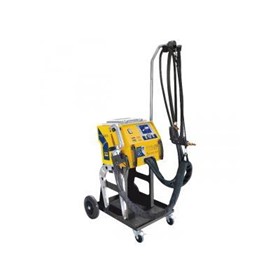

Plan-it Engineering Systems is an Spot Welder supplier to All
As manufacturers of finishing systems for the spray painting and powder coating industries, Plan-It Systems has continually evolved, creating practical designs from innovative ideas resulting in efficient and reliable installations. Our expertise has developed over thirty years in the automotive and industrial finishing industries. We have experience in many fields, such as ...

- Resistance spot welders: These are the most common type of spot welders that use electrical resistance to create heat and weld two metal pieces together.
- Capacitor discharge spot welders: These welders use a high-voltage capacitor to discharge a large amount of energy in a short time to create a weld.
- Pneumatic spot welders: These welders use compressed air to apply pressure to the metal pieces being welded together.
- Inverter spot welders: These are a newer type of spot welder that use an inverter to convert low voltage and high current into high voltage and low current to create a weld.
- Handheld spot welders: These are small, portable spot welders that can be used for small welding jobs.
- Duty Cycle: The duty cycle refers to the amount of time a spot welder can operate continuously before it needs to cool down. A higher duty cycle means that the spot welder can be used for longer periods of time without overheating.
- Electrode Size: The size of the electrodes determines the size of the weld that can be made. Look for a spot welder with electrodes that are large enough to accommodate the size of the workpiece you will be welding.
- Control Panel: A good spot welder should have a control panel that is easy to use and allows you to adjust the welding parameters, such as the welding time and current.
- Safety Features: Look for a spot welder with safety features such as overheat protection, short circuit protection, and automatic shut-off to prevent accidents and damage to the equipment.
- Portability: If you need to move your spot welder around frequently, look for a portable model that is lightweight and easy to transport.
- Wearing appropriate personal protective equipment (PPE) such as safety glasses, gloves, and a welding helmet.
- Ensuring that the work area is well-ventilated to prevent the buildup of toxic fumes.
- Keeping the welding area clear of flammable materials and liquids.
- Checking the equipment for any damage or defects before use.
- Using the appropriate welding settings for the thickness and type of metal being welded.
- Keeping a fire extinguisher nearby in case of an emergency.
- Avoiding touching the electrodes or the metal being welded while the welder is in use.
- Turning off the welder and unplugging it when not in use.
- Disconnect the power source and allow the welder to cool down completely before cleaning.
- Wipe down the exterior of the welder with a clean cloth to remove any dust or debris.
- Use a wire brush to clean the electrodes and remove any buildup or debris.
- Check the electrodes for wear and tear and replace them if necessary.
- Inspect the cables and connections for any signs of damage or wear and replace them if necessary.
- Lubricate the moving parts of the welder with a light machine oil to prevent rust and ensure smooth operation.
- Check the water cooling system and clean or replace the coolant as needed.
- Test the welder to ensure it is functioning properly before use.
- Welding Clamps: Welding clamps are used to hold the two pieces of metal together while welding. They ensure that the metal pieces are in the right position, and that they don't move during the welding process.
- Welding Gloves: Welding gloves protect the hands from the heat generated during the welding process. They also protect the hands from any sparks or debris that may fly off during welding.
- Welding Helmet: Welding helmets protect the eyes and face from the bright light and heat generated during welding. They also protect the skin from any sparks or debris that may fly off during welding.
- Welding Apron: Welding aprons protect the body from the heat generated during welding. They also protect the clothing from any sparks or debris that may fly off during welding.
- Wire Brush: A wire brush is used to clean the metal pieces before welding. It removes any rust, dirt, or other contaminants that may interfere with the welding process.
- Welding Pliers: Welding pliers are used to hold the welding wire and to trim it to the correct length.
- Welding Wire: Welding wire is used to create the weld. It is available in different sizes and types, depending on the metal being welded.
- Ground Clamp: The ground clamp is used to connect the welding machine to the metal being welded. It ensures that the electrical circuit is complete and that the welding process is effective.
Spot Welder Costs and Supplier Insights
If you are looking to buy a Spot Welder for sale, suppliers on IndustrySearch include Hare & Forbes Machinery House
Why choose a supplier in Perth for Spot Welder Quotes?
If you are in Perth and considering purchasing a Spot Welder, it's worth considering Perth-based suppliers. Doing so offers several benefits that are particularly relevant to businesses in the area. Here are the top reasons why opting for a local Perth supplier can be the best decision for your Spot Welder buying needs.
Immediate Spot Welder Availability in PerthBenefit from immediate Spot Welder availability when you choose suppliers in Perth. Quick access to equipment prevents project delays.
Better Service and Maintenance in PerthBenefit from enhanced service and maintenance. Local suppliers can provide quicker, more efficient after-care services.
Quality from Trusted Perth SuppliersExpect high-quality Spot Welder from trusted suppliers. Local suppliers adhere to strict Australian standards, ensuring top-tier products.
Access the Local Spot Welder InnovationsAccess the latest Spot Welder innovations quickly by partnering with suppliers. Access the latest technologies faster with your local supplier.
Cost-Effective Spot Welder SolutionsFind cost-effective Spot Welder solutions when you buy from suppliers in locally. Local sourcing eliminates many hidden costs associated with international shipping.
Comprehensive Spot Welder TrainingReceive comprehensive Spot Welder training from experts. Local suppliers offer detailed training programs that enhance your team's skills and product knowledge.
Buy a Spot Welder Near Me

 Reach valuable industrial buyers in minutes
 Promote key products & content
 Drive cost effective & measurable sales