
Process Indicator & Meter in Adelaide

Join industrial buyers comparing supplier quotes and buying with confidence. Free, quick and easy.


How IndustrySearch works
Tell us what you need
Answer a few quick questions about the equipment you're looking for.
Get personalised quotes
Receive tailored quotes from relevant Australian suppliers.
Compare and choose
Compare quotes, ask questions and choose the best option for you.
 Save time
 Compare quotes
 Buy with confidence
Save time, compare quotes & buy with confidence
Process Indicator & Meter Suppliers in Adelaide
Instrotech Australia is an Process Indicator & Meter supplier to Adelaide
Calibrators, digital indicators, signal conditioners and weighing equipment - Instrotech make panel meters, loop isolators, transmitters, acoustic steam leak detection systems, hand-held calibrators, tank level systems, head mount transmitters, motorsport rally timers, and weight amplifiers. Our equipment is used for temperature, pressure, level, flow and load applications, ...
Process Integrator Totaliser Indicator | Model 5001-T - Instrotech Australia
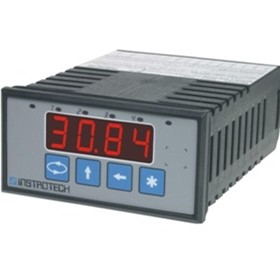
4 Digit AC/DC Process Indicator | Model 4006 - Instrotech Australia

8 Digit Digital Totaliser & Process Integrator | 8001 - Instrotech Australia

Universal Process Indicator & Digital Totaliser | Model 5600 - Instrotech Australia

4 Digit LED Universal Programmable Process Indicator | Model 4001

8 Digit Led Universal Process Indicator | Model 8001 - Instrotech Australia

- Analog indicators: These are simple instruments that use analog dials to display readings. They are commonly used for temperature, pressure, and flow rate measurements.
- Digital indicators: These instruments use digital displays to show readings. They offer greater accuracy and precision than analog indicators and are used for various applications such as pH measurement, conductivity measurement, and turbidity measurement.
- Process controllers: These instruments not only display process variables but also provide control signals to regulate the process. They are used in automated systems to maintain process variables within a set range.
- Panel meters: These are compact instruments that can be mounted on a control panel. They are used for displaying multiple process variables simultaneously.
- Totalizers: These instruments measure and display accumulated values such as total flow rate, total volume, or total energy consumption.
- Batch controllers: These instruments are used to control and monitor batch processes. They can be set to start and stop a process automatically and can display batch size, batch time, and other relevant information.
- Level indicators: These instruments are used to measure and display the level of liquids or solids in tanks, silos, and other containers.
- Type of measurement: What parameter(s) do you need to measure? Common options include temperature, pressure, flow rate, and level. Make sure the indicator and meter you choose are capable of measuring the parameter(s) you need.
- Accuracy: How precise do your measurements need to be? This will depend on the requirements of your process. Some applications may require high accuracy, while others may be more forgiving.
- Range: What range of values do you need to measure? Make sure the indicator and meter you choose are capable of measuring the full range of values you need.
- Display: How do you need to view your measurements? Some indicators and meters have digital displays, while others have analog displays. Some have multiple displays, allowing you to view multiple parameters at once.
- Output: Do you need the indicator and meter to output data to another system? Some options allow for analog or digital outputs, while others may have communication capabilities such as Modbus or Ethernet.
- Environment: What is the environment in which the indicator and meter will be used? Consider factors such as temperature, humidity, and potential exposure to chemicals or other hazards.
- Budget: How much are you willing to spend on an indicator and meter? There are options available at a range of price points, so consider your budget when making your selection.
- Display type: The display type is an important consideration when choosing a process indicator and meter. There are different types of displays available, including LED, LCD, and analog displays. LED displays are easy to read, while LCD displays are more versatile and can display more information. Analog displays are suitable for applications where precise readings are required.
- Accuracy: The accuracy of the process indicator and meter is another important consideration. The accuracy of the device is determined by the number of digits displayed and the resolution of the display. The higher the accuracy, the more precise the readings will be.
- Range: The range of the process indicator and meter refers to the minimum and maximum values that can be measured. It is important to choose a device with a range that is suitable for the application.
- Input type: The input type refers to the type of signal that the device can accept. There are different types of input signals, including analog and digital signals. It is important to choose a device that can accept the input signal that is used in the application.
- Output type: The output type refers to the type of signal that the device can output. The device may have different output options, including analog and digital outputs. It is important to choose a device with the appropriate output type for the application.
- Environmental conditions: The environmental conditions in which the process indicator and meter will be used should also be considered. The device should be able to operate in the temperature, humidity, and other environmental conditions that are present in the application.
- Power supply: The power supply for the process indicator and meter is another important consideration. Some devices may require external power, while others may be powered by batteries or other sources. It is important to choose a device with a power supply that is suitable for the application.
- Choose the right equipment: Ensure that the process indicator and meter are the right size, type, and range for the application.
- Check the wiring: Ensure that the wiring is correct and that all connections are tight and secure.
- Calibrate the meter: Calibrate the meter using a calibrated source, ensuring that the readings are accurate and within the specified range.
- Test the meter: Test the meter in the actual process environment to ensure that it is functioning correctly.
- Verify the calibration: Verify the calibration periodically to ensure that the meter is still accurate and within the specified range.
- Cleaning: Dust and dirt can accumulate on the device and affect its accuracy. Regular cleaning with a soft cloth or brush is recommended.
- Inspection: Regular inspection of the device is necessary to detect any physical damage or wear and tear. Any damaged parts should be replaced immediately.
- Power source: Many process indicators and meters require a power source, such as batteries or AC power. Regularly checking the power source and replacing batteries or ensuring proper electrical connections is important.
- Software updates: Some process indicators and meters require software updates to fix bugs or add new features. Checking for updates and installing them as necessary is important to ensure the device is functioning properly.
- The service support provided by manufacturers or suppliers may include technical support, repair or replacement of defective products, and maintenance services. Some manufacturers or suppliers may also offer training or educational resources to help customers better understand their products or services.
- Identify the requirements: The first step is to identify the requirements of the process indicator or meter. This includes the type of signal or input, the measurement range, accuracy, resolution, display type, and output options.
- Research different brands and models: Research different brands and models that meet the identified requirements. Look for product specifications, features, and customer reviews.
- Compare features and specifications: Compare the features and specifications of each product. This includes the accuracy, resolution, signal compatibility, display type, and output options.
- Evaluate performance metrics: Evaluate the performance metrics of the product. This includes the response time, stability, repeatability, and linearity.
- Consider the price: Consider the price of each product along with the features and performance metrics.
- Choose the best product: After evaluating all the above factors, choose the product that best meets the requirements and offers the best value for money.
Process Indicator & Meter Costs and Supplier Insights
If you are looking to buy a Process Indicator & Meter for sale, suppliers on IndustrySearch include Instrotech Australia
Why choose a supplier in Adelaide for Process Indicator & Meter Quotes?
If you are in Adelaide and considering purchasing a Process Indicator & Meter, it's worth considering Adelaide-based suppliers. Doing so offers several benefits that are particularly relevant to businesses in the area. Here are the top reasons why opting for a local Adelaide supplier can be the best decision for your Process Indicator & Meter buying needs.
Access to Process Indicator & Meter Training Experts in AdelaideGain direct access to Process Indicator & Meter training experts. Local suppliers can provide tailored instruction that fits your specific needs and challenges.
Trustworthy Process Indicator & Meter Procurement in AdelaideTrust your Process Indicator & Meter procurement with Adelaide suppliers known for their reliability and commitment to quality.
Cost-Effective Process Indicator & Meter SolutionsFind cost-effective Process Indicator & Meter solutions when you buy from suppliers in locally. Local sourcing eliminates many hidden costs associated with international shipping.
Stay Ahead in Process Indicator & Meter TechnologyStay ahead in Process Indicator & Meter technology with the help of local suppliers. They bring the newest advancements directly to your doorstep, keeping you competitive.
Support Local Industry with Process Indicator & Meter PurchasesSupport local industry and commerce by choosing Process Indicator & Meter from Adelaide. Every purchase helps sustain and grow the local business ecosystem.
Secure Your Inventory with Local SuppliersSecure your Process Indicator & Meter inventory by partnering with local suppliers in Adelaide. Reduce the likelihood of stock shortages and logistical issues.
Buy a Process Indicator & Meter Near Me
Process Indicator & Meter Articles & Reviews


 Reach valuable industrial buyers in minutes
 Promote key products & content
 Drive cost effective & measurable sales